


Every patient-contact surface in an exam room must be cleaned and disinfected between every patient, regardless of visible soil. That is the non-negotiable baseline established by PICNet and reinforced throughout PIDAC and Public Health Agency of Canada (PHAC) guidance. Layer on top of that a defined daily, weekly, and monthly task structure tied to your patient throughput and IPC risk profile, and you have a compliant cleaning schedule for exam rooms that holds up to audit.
Immediate must-dos:
- Disinfect all patient-contact surfaces (exam table, shared equipment, high-touch points) between every patient; use a Health Canada–approved disinfectant and observe the full manufacturer wet contact time before wiping dry.
- Perform an IPC Risk Assessment (IPC RA) before each cleaning task to select correct PPE and method based on potential exposure to blood or body fluids.
Staffing and recordkeeping priority: Assign cleaning responsibilities in writing, document every completed task, and verify staff competency against your SOPs at least monthly.
Table of Contents
- What does a compliant cleaning schedule for exam rooms look like?
- How do you build a schedule that fits your specific clinic?
- What are the core IPC protocols every exam room cleaner must follow?
- Ready-to-use checklists for your exam room sanitation plan
- How do training, audits, and documentation keep your schedule working?
- When should you escalate beyond the standard protocol?
- Key Takeaways
- Why the schedule matters more than the product you choose
- Lightning Cleaning brings medical-grade cleaning to Durham Region clinics
- Useful sources
- FAQ
What does a compliant cleaning schedule for exam rooms look like?
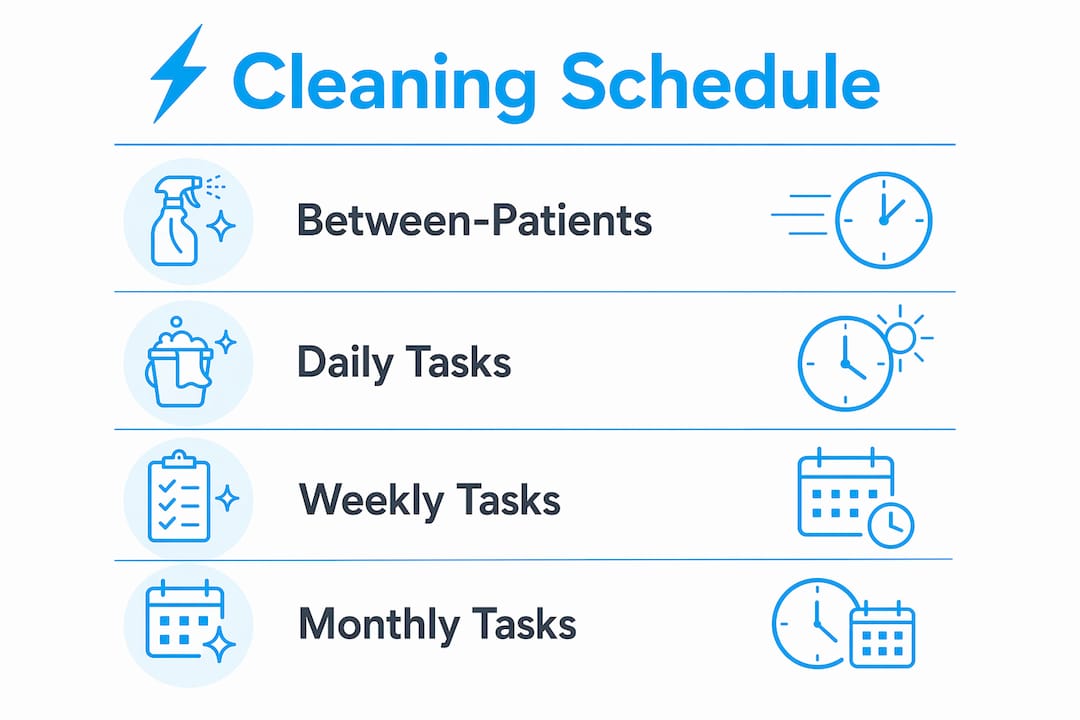
The table below maps the core tasks to frequency, typical performer, and a realistic time estimate per standard exam room. Adjust minutes upward for high-throughput clinics or rooms used for aerosol-generating procedures.

| Task | Frequency | Typical Performer | Est. Time |
|---|---|---|---|
| Disinfect exam table, pillow, stirrups | Between every patient | Clinical staff | 3–5 min |
| Wipe shared equipment (BP cuff, otoscope, scale) | Between every patient | Clinical staff | 2–3 min |
| High-touch surfaces (door handle, light switch, counter) | Between every patient | Clinical staff | 2 min |
| Change table paper/cover | Between every patient | Clinical staff | 1 min |
| Check and replace sharps container (if ¾ full) | Between every patient | Clinical staff | 1 min |
| Waste bin check and liner replacement | Daily (end of day) | EVS / cleaning staff | 2 min |
| Floor cleaning (sweep and mop/disinfect) | Daily (end of day) | EVS / cleaning staff | 5–8 min |
| High-level dusting (shelves, vents, light fixtures) | Weekly | EVS / cleaning staff | 5 min |
| HVAC vent and filter inspection | Monthly | Facilities / EVS | 10 min |
| Deep clean of all surfaces and equipment | Monthly | EVS / cleaning staff | 20–30 min |
| Disinfectant inventory check | Monthly | Clinic manager | 5 min |
DivisionsBC / BCCDC guidance recommends increasing all frequencies during outbreaks, so build that escalation trigger into your SOP from day one.
Pro Tip: For a clinic seeing 20 or more patients per day, budget an extra 15–20 minutes of EVS time at end of day to cover the accumulated high-touch surface load that clinical staff may have missed during turnover.
How do you build a schedule that fits your specific clinic?
Start with three variables: patient throughput, room function, and risk profile. A general-practice exam room used for routine check-ups carries a different risk level than one used for minor procedures or wound care. Patient throughput and room count directly shape how much time you need to allocate per clean.
- Map your patient flow. Count average daily patients per room. Rooms seeing more than eight patients per day need a dedicated between-patient cleaning slot built into the appointment schedule, not squeezed in ad hoc.
- Define the minimum standard. Every exam room, regardless of use, requires between-patient disinfection of all patient-contact surfaces. This is the floor, not the ceiling.
- Assign responsibilities clearly. Clinical staff handle between-patient tasks; EVS or contracted cleaning staff handle end-of-day and scheduled deep cleans. Written cleaning policies with defined responsibilities are required — if cleaning is contracted, the contractor must have documented procedures for each clinical area.
- Create a reusable checklist. Build one checklist per frequency tier (between-patient, daily, weekly, monthly) and attach each to your SOP binder. Staff sign off on completion; managers review weekly.
- Pilot before full rollout. Run the schedule for 2–4 weeks, then audit. Adjust time allocations and staffing before locking the SOP.
Pro Tip: Slot between-patient cleaning into the appointment booking system itself. A 10-minute buffer between appointments is far easier to defend to schedulers when it is labeled “room preparation” in the calendar.
What are the core IPC protocols every exam room cleaner must follow?
Three rules govern every cleaning task in a clinical setting: perform an IPC RA first, wear the right PPE, and never wipe a disinfected surface dry before the manufacturer’s wet contact time has elapsed.
Cleaning removes soil. Disinfection inactivates microorganisms. You cannot skip the first step. Applying a disinfectant to a visibly soiled surface reduces its efficacy — dust, dirt, and organic matter physically block the active ingredient from reaching the surface. Always clean before you disinfect, following the order of operations established in PIDAC environmental cleaning guidance.
The IPC RA step is brief but mandatory: before entering a room, assess whether blood or body fluids are present, whether the previous patient was under additional precautions, and what PPE the task requires. This takes under a minute and determines glove type, gown need, and eye protection.
Wet contact time is where most clinics fail. Wiping a surface dry immediately after applying disinfectant is one of the most common compliance errors observed in clinical settings. The surface must stay visibly wet for the full duration specified on the product label.
For surfaces and furnishings, choose non-porous, smooth, water-resistant finishes and remove any fabric-covered or unfinished wood items that cannot be adequately disinfected. On cloth management: use a fresh cloth for each room, never re-dip a used cloth into the disinfectant solution, and change cloths when visibly soiled or when moving from a dirty area to a clean one.
Ready-to-use checklists for your exam room sanitation plan
Between-patient checklist (3–5 min per room)
- Perform IPC RA and don appropriate PPE before entering.
- Apply Health Canada–approved disinfectant (with valid Drug Identification Number) to exam table, pillow, and any patient-contact attachments; allow full wet contact time.
- Wipe shared equipment: blood pressure cuff, otoscope handle, thermometer, scale platform.
- Disinfect high-touch surfaces: door handle, light switch, counter edge, cabinet pulls.
- Replace table paper or cover.
- Check sharps container; replace if at the ¾ fill line.
- Remove and dispose of any single-use items; tie off waste bag if full.
- Remove PPE and perform hand hygiene.
End-of-day and weekly/monthly tasks
| Task | Frequency | Responsible Role | Est. Time |
|---|---|---|---|
| Mop and disinfect floor | Daily | EVS | 5–8 min |
| Empty and reline all waste bins | Daily | EVS | 2 min |
| Wipe sink, faucet, soap dispenser | Daily | EVS | 2 min |
| High-level dusting (shelves, vents) | Weekly | EVS | 5 min |
| Clean interior of cabinets | Monthly | EVS | 10 min |
| Inspect and clean HVAC vents/filters | Monthly | Facilities | 10 min |
| Deep-clean all surfaces and equipment | Monthly | EVS | 20–30 min |
| Audit disinfectant stock and expiry dates | Monthly | Clinic manager | 5 min |
All disinfectants used must carry a valid Health Canada Drug Identification Number (DIN) and be appropriate for clinical use. Ready-to-use disinfectant wipes reduce dilution errors, but verify each product’s label for contact time and surface compatibility before adding it to your supply list.
How do training, audits, and documentation keep your schedule working?
PIDAC guidance is direct: clinical cleaning intensity must align with infection risk, not office cleaning norms. That means staff need training specific to IPC principles, product instructions for use (IFUs), and your facility’s SOPs—not just a general orientation.
Document every training session with the date, staff name, topics covered, and the trainer’s signature. Run competency checks at onboarding and at least annually after that, with spot checks whenever a new product or protocol is introduced. For healthcare cleaning certifications available in Canada, look to programs aligned with IPAC standards.
For audits, a practical rhythm is weekly spot checks on between-patient compliance (cloth management and wet contact time are the two behaviors to watch) and a formal monthly audit covering the full schedule. Record findings in a corrective-action log: date, room, issue observed, corrective action taken, and follow-up date. A simple documentation template for each completed clean should capture who cleaned, when, what product was used, and whether the contact time was observed. That log is your proof of compliance during a public health inspection.
When should you escalate beyond the standard protocol?
Not every situation fits the routine schedule. Use this decision sequence when conditions change:
- Suspected or confirmed infectious patient — increase cleaning frequency for that room immediately; add PPE appropriate to the suspected pathogen; notify the infection control lead.
- Blood or body fluid spill — stop routine cleaning, don full spill-response PPE (gloves, gown, eye protection), contain the spill with absorbent material, apply a sporicidal or appropriate disinfectant per your biohazard spill protocol, and dispose of all materials as biohazardous waste.
- Vomiting or diarrhea contamination — treat as a potential norovirus event; use a chlorine-based disinfectant at the concentration specified in your SOP; ventilate the room before re-entry.
- Aerosol-generating procedure — allow adequate air-change time before entering for cleaning; confirm ventilation rate with your facilities team.
- Multi-patient outbreak signal — activate facility-wide escalation; increase high-touch surface cleaning to more than once daily; contact your local public health unit.
For biohazard spills beyond in-house EVS capacity, engage a specialized biohazard cleaning team. Sharps disposal must follow provincial regulations: never overfill containers past the ¾ line, seal and label before removal, and use a licensed medical waste contractor. Exposure incidents require immediate reporting per your facility’s PPE and exposure reporting policy. For clinical infection control guidance, managing contaminated environments follows the same IPC principles that govern exam room escalation.
Key Takeaways
A compliant exam room cleaning schedule requires between-patient disinfection of all patient-contact surfaces, strict adherence to manufacturer wet contact times, and documented IPC risk assessments before every cleaning task.
| Point | Details |
|---|---|
| Between-patient disinfection | Clean and disinfect all patient-contact surfaces between every patient, regardless of visible soil. |
| Wet contact time | Never wipe a disinfected surface dry early; the surface must stay wet for the full manufacturer-specified duration. |
| IPC risk assessment | Perform an IPC RA before each cleaning task to select the correct PPE and method. |
| Documentation and audits | Log every completed clean; run weekly spot checks and monthly formal audits with corrective-action records. |
| Lightning Cleaning support | Lightning Cleaning provides medical facility cleaning in Durham Region, including custom SOPs, staff training, and audit templates. |
Why the schedule matters more than the product you choose
Most clinic managers focus on which disinfectant to buy. The harder problem is consistency. A hospital-grade disinfectant applied incorrectly, wiped dry in 10 seconds, or used with a re-dipped cloth delivers worse outcomes than a basic product used exactly right. The schedule, the training, and the audit cadence are what convert a good product into actual infection control.
Durham Region clinics face a real scheduling pressure: appointment slots are tight, and between-patient cleaning competes directly with the next patient’s check-in. The fix is structural, not motivational. Build the cleaning buffer into the booking system, assign it to a named role, and audit it weekly. Clinics that treat cleaning as a documented clinical task rather than a housekeeping afterthought see fewer compliance gaps and handle public health inspections with confidence.
Lightning Cleaning brings medical-grade cleaning to Durham Region clinics
Clinics that want a fully implemented exam room cleaning program, not just a checklist, can work directly with Lightning Cleaning. Our medical facility cleaning service covers Durham Region, including Oshawa, Whitby, Ajax, Pickering, and Clarington, with secondary coverage in Scarborough, Markham, and Vaughan.
We build custom SOPs aligned with PIDAC and PHAC standards, train EVS staff on IPC principles and correct cloth management, and provide audit templates your team can use for ongoing compliance. The result: fewer appointment disruptions, documented cleaning records, and a facility that meets provincial inspection standards. Call 289-355-9691 for a free on-site quote and find out how we can take the scheduling and compliance burden off your clinical team.
Useful sources
- PICNet: Environmental Cleaning and Disinfection for Clinic Settings — between-patient disinfection rule and cloth management guidance.
- Public Health Ontario / PIDAC: Best Practices for Environmental Cleaning — cleaning vs. disinfection order of operations, wet contact time, surface selection.
- Public Health Ontario: IPAC Checklist for Clinical Office Practice — written policy and responsibility assignment requirements.
- Alberta Health Services: IPC Risk Assessment — PPE selection and pre-clean risk evaluation.
- PHAC: Routine Practices and Additional Precautions — high-touch surface frequency and outbreak escalation.
- DivisionsBC / BCCDC: Environmental Cleaning and Disinfectants for Clinic Settings — daily and outbreak-frequency guidance.
- Health Canada: Disinfectant Product Approval (DIN) — verify active listings for clinical disinfectants.
- Lightning Cleaning: Medical Facility Cleaning — implementation support for Durham Region clinics.
- Lightning Cleaning: High-Touch Surface Protocol Guide — detailed surface-by-surface disinfection guidance.
FAQ
What surfaces must be cleaned between every patient?
All surfaces that come into direct contact with a patient must be cleaned and disinfected between every patient, including the exam table, shared equipment such as blood pressure cuffs and otoscopes, and high-touch points like door handles and light switches.
How long does between-patient cleaning take in an exam room?
A thorough between-patient clean typically takes several minutes per room, covering disinfection of patient-contact surfaces, equipment wipe-down, table paper replacement, and a sharps container check.
What is wet contact time and why does it matter?
Wet contact time is the duration a disinfectant must remain visibly wet on a surface to inactivate pathogens, as specified by the manufacturer. Wiping the surface dry before that time has elapsed is one of the most common compliance failures in clinical settings.
Who is responsible for cleaning exam rooms in a clinic?
Clinical staff typically handle between-patient tasks during appointment turnover, while EVS or contracted cleaning staff manage end-of-day, weekly, and monthly tasks. Written SOPs must define these responsibilities clearly, and any contracted cleaner must have documented procedures for each clinical area.
How often should exam room cleaning records be audited?
Weekly spot checks on between-patient compliance and monthly formal audits covering the full schedule are a practical minimum. Record findings and corrective actions in a log that can be produced during a public health inspection.


