


A school cleaning protocol is a documented set of procedures and schedules that facility managers use to maintain hygienic, safe environments for students and staff. The industry term for this system is a custodial management program, and it covers everything from daily restroom sanitation to seasonal deep cleaning of floors and ventilation systems. Without a formal protocol, cleaning becomes reactive and inconsistent, which creates real health risks. Schools that operate with clear, measurable expectations see stronger compliance, fewer illness outbreaks, and more accountable staff performance.
What is school cleaning protocol and why does it matter?
A school cleaning protocol defines who cleans what, when, how, and to what standard. It replaces informal habits with documented Standard Operating Procedures, known as SOPs, that any trained staff member can follow. SOPs specify the task, the approved cleaning product, the personal protective equipment required, and the measurable outcome expected.
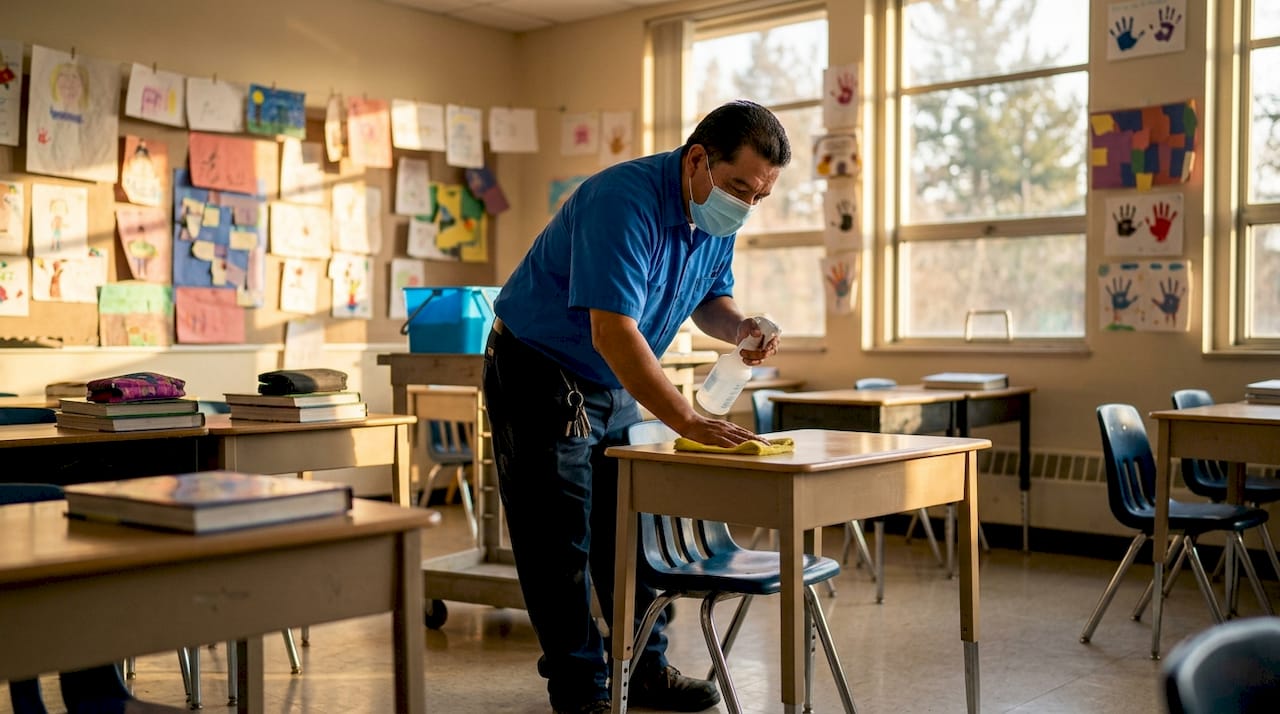
The stakes are high. Schools are high-density environments where infection control and high-touch surface disinfection are critical for regulatory compliance and community confidence. Door handles, light switches, shared desks, and cafeteria tables can transfer pathogens rapidly across a student population. A protocol forces consistent attention to these surfaces every single day.
Regulatory bodies and custodial industry standards, including the APPA (Association of Physical Plant Administrators) framework, provide benchmarks that administrators can reference when building or auditing their own programs. These standards give facility managers a common language for measuring cleanliness rather than relying on subjective impressions.
Core components of an effective cleaning protocol
Every effective school cleaning protocol contains five core elements: a tiered schedule, written SOPs, approved product lists, equipment assignments, and safety procedures.
The tiered schedule is the backbone. A three-tier cleaning system structures tasks into daily hygiene maintenance, weekly detail cleaning, and term or holiday deep cleans that reset the facility. Daily tasks keep the school functional. Weekly tasks address buildup. Term-based deep cleans, such as floor stripping and carpet extraction, restore surfaces to baseline condition.
Written SOPs define each task precisely. A good SOP for restroom cleaning, for example, specifies the disinfectant concentration, the dwell time before wiping, the order of surfaces to clean, and the disposal method for used materials. Vague instructions produce inconsistent results.
- Approved product list: Only use products rated safe for school environments, including low-VOC disinfectants and pH-neutral floor cleaners.
- Equipment assignments: Assign color-coded microfiber cloths by zone to prevent cross-contamination between restrooms and food areas.
- PPE requirements: Specify gloves, eye protection, and footwear for each task category.
- Responsibility matrix: Name the staff member or team accountable for each zone and shift.
Pro Tip: Create a one-page SOP summary card for each zone and laminate it. Staff can reference it during the shift without hunting through a binder.
How are school cleaning schedules structured?
School cleaning schedules are structured by frequency, area type, and time of day. The goal is to match cleaning intensity to contamination risk and traffic volume.
Restrooms carry the highest contamination risk. Restrooms require 2–3 cleanings per day, dining halls are cleaned after every service, and classrooms receive daily trash removal with weekly deep cleaning. That frequency is not arbitrary. It reflects the rate at which pathogens accumulate on shared surfaces in high-use spaces.
The sequence of tasks within a shift also matters. Cleaning should always move from least contaminated to most contaminated areas, and from high surfaces to low surfaces, so debris falls onto areas not yet cleaned.
- Start with administrative offices and hallways before students arrive.
- Clean classrooms during lunch periods or after dismissal.
- Service restrooms at mid-morning, post-lunch, and end of day.
- Sanitize cafeteria surfaces immediately after each meal service.
- Complete floor care last, after all other surfaces are addressed.
The table below shows how cleaning frequency maps to area type and risk level.
| Area | Daily Tasks | Weekly Tasks | Term/Holiday Tasks |
|---|---|---|---|
| Restrooms | Disinfect all surfaces, restock supplies | Scrub grout, clean vents | Deep descale, reseal floors |
| Classrooms | Trash removal, wipe desks | Vacuum, mop floors | Strip and wax floors |
| Cafeteria | Sanitize tables, sweep and mop | Degrease equipment | Deep clean kitchen exhaust |
| Hallways | Spot clean, sweep | Mop, wipe lockers | Polish floors, clean windows |
| Gyms | Spot clean, trash removal | Disinfect mats, mop | Deep clean bleachers, vents |
Summer and holiday periods are the right time for what facility managers call a seasonal deep clean. This includes tasks that cannot happen during the school year without disrupting operations, such as floor waxing and carpet cleaning, repainting high-traffic walls, and cleaning HVAC ducts.
What is a school cleaning inspection?
A school cleaning inspection is a structured review that measures whether cleaning tasks were completed to the defined standard. Inspections are the accountability mechanism that keeps a protocol from becoming a paper exercise.
The APPA appearance level system gives inspectors a consistent rating scale. APPA appearance levels range from 1 (Orderly Spotlessness) to 5 (Unkempt Neglect), with Level 2 as the target for most school general spaces. Using this scale, a supervisor can rate a classroom or restroom objectively and track scores over time.
Effective audits combine weekly spot checks with comprehensive monthly audits, which enables trend tracking rather than isolated incident reactions. A single failed inspection tells you one room was missed. A pattern of failures tells you a systemic problem exists, whether that is a staffing gap, a training deficiency, or an equipment failure.
- Spot checks: Unannounced, 10–15 minute reviews of 3–5 areas per shift.
- Monthly audits: Structured walkthroughs covering all zones with scored checklists.
- Photographic evidence: Photos of failures create an objective record and support corrective action.
- Digital workflows: Inspection software assigns failed items as work orders with named owners and due dates.
Cleaning audits reveal patterns that help managers intervene before complaints or health concerns arise. That proactive posture is what separates a well-managed school from one that only reacts to problems after they become visible.
Pro Tip: Schedule at least one unannounced spot check per week per building. Predictable inspections only measure compliance on inspection day.
Practical tips for implementing your cleaning protocol
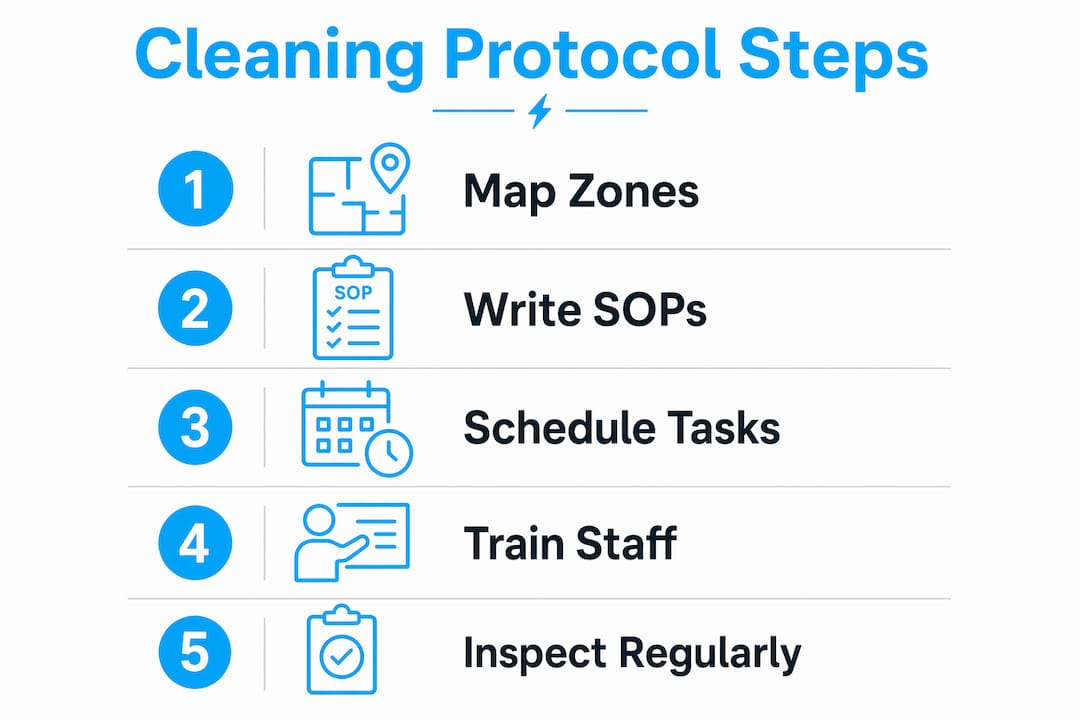
Building a protocol from scratch feels large, but the process becomes manageable when broken into four steps.
Map your zones first. Defining cleaning scope by mapped school zones rather than room lists prevents overlooked areas such as vents, under furniture, and stairwells. A zone map assigns a unique identifier to every physical space, making it impossible to accidentally skip an area.
Write closed-loop SOPs. SOPs fail when treated as static documents. Effective protocols integrate digital closed-loop systems that trigger automatic work orders and require photographic verification when an inspection finds a failure. This removes ambiguity about whether a problem was actually corrected.
Train staff on the “why,” not just the “how.” Staff who understand that a missed restroom cleaning can contribute to a norovirus outbreak take their work more seriously than staff who only know they are supposed to clean at 10:00 AM. Connect the task to the health outcome.
- Conduct hands-on training for each SOP, not just verbal briefings.
- Use before-and-after photos in training to set visual standards.
- Hold brief weekly team check-ins to surface supply issues or scheduling conflicts early.
- Review and update SOPs at the start of each school year to reflect any changes in products, equipment, or regulations.
Pro Tip: Assign a lead custodian per building as the protocol owner. This person owns the zone map, the SOP binder, and the inspection log. Distributed ownership without a single point of accountability produces gaps.
Key Takeaways
A school cleaning protocol is only as strong as its inspection system. Without regular audits, even the best-written SOPs degrade into inconsistent practice.
| Point | Details |
|---|---|
| Three-tier schedule | Structure tasks as daily, weekly, and term-based to match cleaning intensity to contamination risk. |
| Written SOPs | Define every task with product, PPE, dwell time, and measurable outcome to eliminate guesswork. |
| APPA Level 2 target | Use the APPA 1–5 rating scale to set and measure a consistent cleanliness standard across all spaces. |
| Closed-loop inspections | Pair spot checks and monthly audits with digital work orders and photo evidence to verify corrections. |
| Zone mapping | Map every physical space by zone, not room name, to prevent overlooked areas from falling outside the protocol. |
Why I think most schools underinvest in their inspection culture
I have worked with enough school facilities to know that the protocol document is rarely the problem. Most schools have a binder somewhere. The real gap is almost always in the inspection layer. Administrators write the SOPs, hand them to the custodial team, and then assume the work is being done correctly because no one is complaining.
Complaints are a lagging indicator. By the time a parent calls about a dirty restroom or a teacher flags a mold smell in a classroom, the problem has been building for weeks. A strong inspection culture catches those patterns at week one, not week six.
The post-pandemic period changed what “clean enough” means in a school. Cleaning is now a health-critical operation, not a cosmetic service. Administrators who still treat it as a background function are taking on real liability. The schools that handle this well treat their custodial program the same way they treat their fire safety program: documented, audited, and updated on a fixed schedule.
The other thing I would push back on is the idea that technology is optional. Digital inspection tools that generate automatic work orders and photo logs are not expensive luxuries. They are the difference between a protocol that lives in a binder and one that actually runs the building. If your team is still using paper checklists, you are flying blind on trend data.
— William
Professional school cleaning services from Lightningcleaning
Lightningcleaning provides school cleaning services built around the same tiered scheduling, zone mapping, and inspection standards described in this article. Our team works with school administrators and facility managers across the Durham Region to build customizable cleaning programs that meet health and safety requirements.
We handle everything from daily classroom and restroom maintenance to seasonal deep cleans during summer and holiday periods. Every service includes trained staff, approved products, and documented procedures. If you want a cleaning program that holds up to scrutiny, contact Lightningcleaning for a consultation and accurate quote tailored to your facility.
FAQ
What is a school cleaning protocol?
A school cleaning protocol is a documented set of SOPs, schedules, and standards that define how, when, and to what level a school facility must be cleaned and disinfected.
How often should school restrooms be cleaned?
Restrooms require 2–3 cleanings per day, with full disinfection of all surfaces at each service to control pathogen transmission.
What is the APPA cleaning standard for schools?
The APPA system rates facility cleanliness on a scale from 1 (Orderly Spotlessness) to 5 (Unkempt Neglect). Most schools target Level 2 for general spaces.
What is seasonal deep cleaning for schools?
Seasonal deep cleaning is a term-based or holiday-period cleaning cycle that covers tasks not possible during the school year, such as floor stripping, carpet extraction, and HVAC duct cleaning.
How does a school cleaning inspection work?
A cleaning inspection uses scored checklists and the APPA appearance level scale to rate each zone, with failures generating corrective work orders supported by photographic evidence.


