


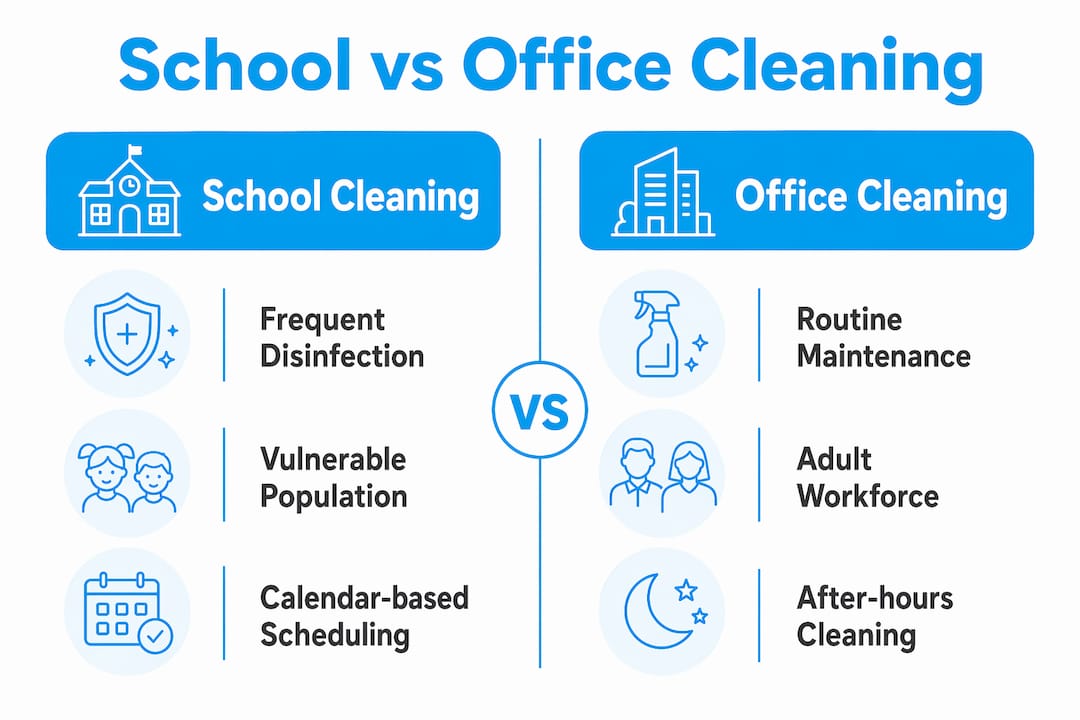
School cleaning requires different protocols, products, schedules, and staff controls than office cleaning because it prioritizes infection prevention for a vulnerable, high-touch population. Children have developing immune systems, occupy shared spaces at high density, and touch dozens of common surfaces every hour. That combination demands a stricter operational model than any standard office program delivers.
Here is what that means in practice:
- Product safety: Low-toxicity, fragrance-free or low-fragrance disinfectants and cleaners, aligned with Health Canada guidance for use around children
- Infection prevention focus: Clean to remove soil first, then disinfect — a sequence Public Health Ontario identifies as the foundation of effective environmental cleaning
- Higher frequency on high-touch points: Desks, door handles, faucets, and shared equipment cleaned more often than in a typical office
- Academic-calendar scheduling: Deep cleans tied to summer break and term ends, not fiscal quarters
- Specialized deep cleans and outbreak response: Defined triggers and step-by-step protocols for communicable disease events
- Vetted, trained staff: Vulnerable sector screening, IPAC basics, and WHMIS competency required for anyone working in a school
Lightning Cleaning builds every school contract around these requirements, applying them to facilities across Durham Region.
Table of Contents
- What does school cleaning actually involve, area by area?
- Why does cleaning quality directly affect student health and attendance?
- How does school cleaning differ from office cleaning? A practical comparison
- How should you schedule cleaning around the academic calendar?
- What products and PPE does Canadian compliance require for school cleaning?
- What staff vetting and training should you require for school cleaners?
- What documentation and quality checks should you require?
- How should you handle deep cleans and outbreak response?
- How Lightning Cleaning approaches school cleaning in Durham Region
- Key Takeaways
- The detail in the contract is where school cleaning succeeds or fails
- Lightning Cleaning serves Durham Region schools with documented, compliant programs
- Useful sources and further reading
- FAQ
What does school cleaning actually involve, area by area?
Schools are not uniform spaces. A single building can contain classrooms, washrooms, a cafeteria, a gymnasium, a library, computer labs, science rooms, art studios, and administrative offices, each with its own cleaning requirements. A one-size-fits-all office approach fails here because the surfaces, materials, and contamination risks differ by room.
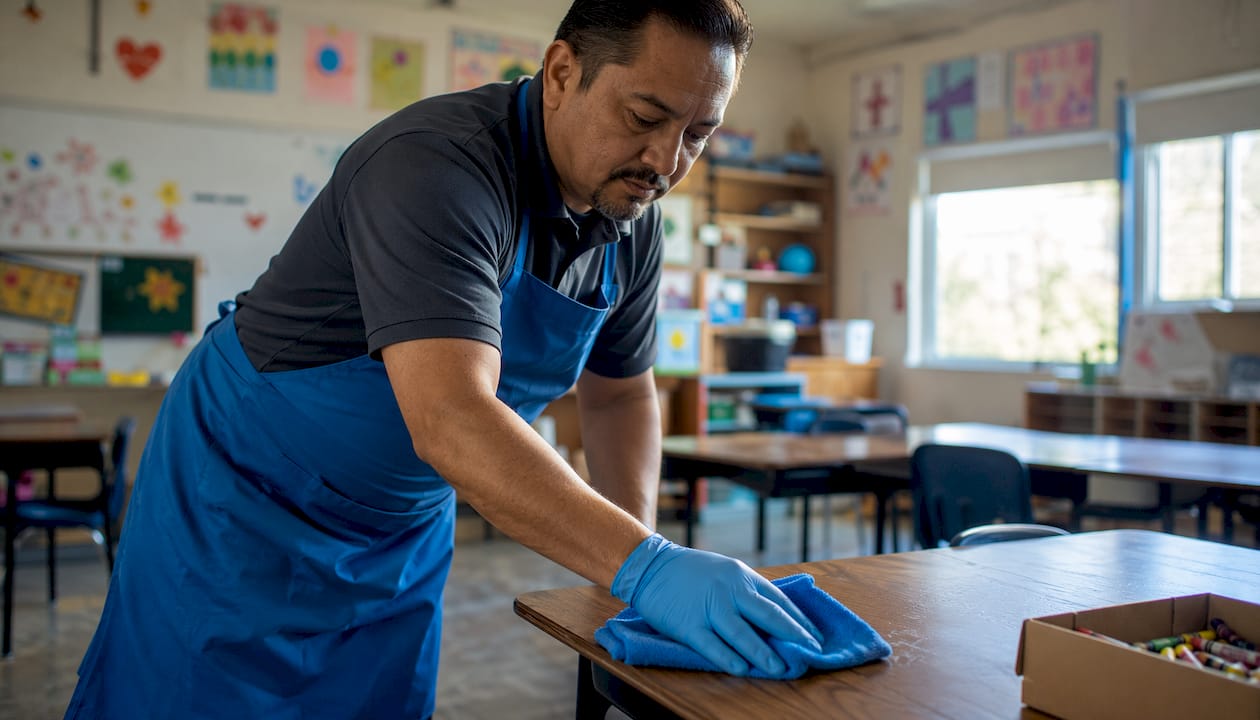
Classrooms: Wipe desks and chair surfaces daily. Clean shared manipulatives, art supplies, and learning tools regularly. Sanitize door handles, light switches, and pencil sharpeners as high-touch points.
Washrooms: Daily fixture cleaning and disinfection, with attention to faucets, flush handles, and door hardware. Restock supplies and inspect for spills or biohazard situations at every visit.
Cafeterias and food areas: Clean tables and service counters between lunch periods. Remove waste promptly and sanitize food-contact surfaces. Coordinate waste removal with lunch schedules.
Gyms: Floor care matched to surface type (hardwood, rubber, or sport tile). Wipe down shared equipment, mats, and benches. Increase frequency during sports seasons.
Libraries and computer labs: Use electronics-safe cleaning products on keyboards, mice, and screens. Avoid excess moisture near equipment.
Science and art rooms: Follow specific protocols for chemical residues, art materials, and biological specimens. Maintain separate cleaning tools for these rooms to prevent cross-contamination.
Playgrounds and lockers: Wipe accessible surfaces and handles. Locker areas need regular floor and surface attention, especially during cold and flu season.
Pro Tip: Color-code microfiber cloths and mop heads by zone — one color for washrooms, another for classrooms, another for food areas. This single step prevents cross-contamination and is easy to verify during spot checks.
Good documentation ties all of this together. Signed daily logs, cleaning schedule posters visible to staff, and SDS/MSDS records on site are the baseline. Manitoba’s Routine Practices guide recommends developing specific cleaning and sanitizing schedules for frequently touched and shared items, with manufacturer instructions followed at every step.
Why does cleaning quality directly affect student health and attendance?
School cleaning is driven by infection prevention and control (IPAC) because children’s immune systems are still developing. That single fact changes everything about how cleaning is specified, performed, and verified compared to an office environment.
The connection between cleaning quality and student outcomes is well documented. Jurisdictional reports and practitioner summaries from BC cite reductions in absenteeism of 15–30% in schools that adopted rigorous cleaning protocols. Fewer sick days mean fewer disruptions to instruction, more consistent learning, and lower administrative burden from managing absences.
For a facilities manager, the practical KPIs to track are:
- Reduction in reported illness outbreaks per term
- Completion rate of scheduled cleaning tasks (target: 95%+)
- Response time to spill or biohazard incidents
- Cleanliness audit scores from spot checks or third-party inspections
A well-run cleaning program also reduces reputational risk. Parents, school boards, and public health inspectors all have visibility into school hygiene. A documented, verifiable program is your best defense when questions arise. The link between cleaning and student health is direct enough that it belongs in every facilities manager’s budget justification.
How does school cleaning differ from office cleaning? A practical comparison
The differences in cleaning schools and offices go beyond frequency. They touch product selection, staffing controls, scheduling logic, and documentation requirements. Canadian building cleaning standards place educational facilities at a higher standard of attention than general offices.
| Factor | School cleaning | Office cleaning |
|---|---|---|
| Population | Children with developing immunity; high density | Adults; moderate density |
| Product requirements | Low-toxicity, fragrance-free; Health Canada-aligned | Standard commercial formulations |
| Cleaning frequency | High-touch points cleaned multiple times daily | Daily or nightly general clean |
| Scheduling driver | Academic calendar (term start, exams, summer) | Business hours and fiscal calendar |
| Staff vetting | Vulnerable sector screening required | Standard background check |
| Staff training | IPAC basics + WHMIS mandatory | WHMIS standard |
| Documentation | Prescriptive daily logs, parent/staff communication | Basic service records |
| Outbreak response | Defined triggers and step-by-step protocols | Ad hoc response |
| Specialized spaces | Labs, gyms, cafeterias, art rooms | Meeting rooms, open offices |
A few of these differences deserve more detail.
Population vulnerability and density. Children share pencils, instruments, sports equipment, and door handles constantly. That density and sharing behavior means pathogens spread faster than in an office, so frequency and product efficacy matter more.
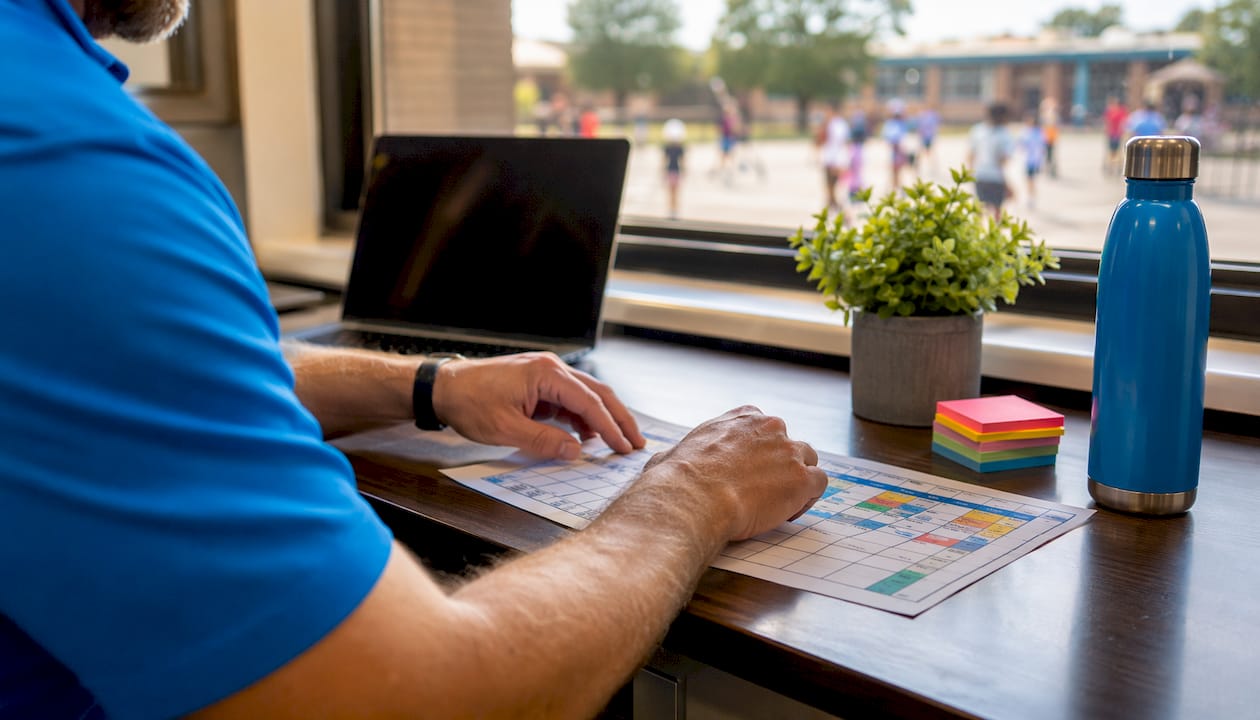
Scheduling and access. Office cleaners typically work after hours with uninterrupted access. School cleaners work around class times, extracurriculars, and community use of facilities. Contracts must account for restricted access windows and after-hours or weekend work for events.
Staffing controls. Any staff member entering a school must hold a current vulnerable sector check. This is a legal and ethical requirement, not a preference.
Pro Tip: When writing a school cleaning contract, include a clause that ties summer deep-clean windows and mid-year intensive cleans to the academic calendar rather than fiscal quarters. This prevents scheduling conflicts and keeps deep cleans from landing during active instruction periods.
How should you schedule cleaning around the academic calendar?
Timing is one of the clearest practical differences between school vs office cleaning methods. Offices offer predictable after-hours windows. Schools do not.
Cleaning schedules tied to academic events minimize instructional disruption and reduce costs by concentrating intensive work in non-instructional windows.
| Frequency | Task | Academic trigger |
|---|---|---|
| Daily | High-touch wipe-downs, washroom cleaning, waste removal | Every school day |
| Weekly | Floor maintenance, locker area cleaning | Ongoing during term |
| Monthly | Deep floor care, equipment wipe-downs | Mid-term |
| End of term | Intensive classroom and common-area deep clean | Before each break |
| Summer | Full building deep clean, HVAC attention, floor stripping/waxing | July–August |
| Event-based | Gym, cafeteria, and common areas after events | Post-sports, concerts, community use |
Key scheduling considerations:
- Orientation and first week of term: High-traffic period; increase frequency on entrances, washrooms, and common areas
- Exam periods: Minimize disruption; schedule noisy or disruptive tasks outside exam hours
- Sports seasons: Gym and locker room frequency increases; coordinate with coaches on equipment access
- After-school programs and community use: Require a post-use clean before the next school day
- Cafeteria waste: Remove waste immediately after each lunch period; do not let it sit until the nightly clean
CCOHS recommends cleaning at least once per day in many workplaces, with higher frequency (every 2–3 hours) in high-use settings. School washrooms and cafeterias fall squarely in that high-use category.
What products and PPE does Canadian compliance require for school cleaning?
Product selection is where the differences in cleaning schools and offices become most concrete. Health Canada and WHMIS guidance favor lower-toxicity, fragrance-free formulations for use around children. Fragrance-free matters because many students have asthma or sensitivities, and strong chemical odors in enclosed classrooms create real health risks.
Product selection rules for schools:
- Prefer disinfectants with a Health Canada Drug Identification Number (DIN) and a child-safe toxicity profile
- Avoid high-VOC or strongly fragranced products in classrooms and occupied spaces
- Use dilution-controlled dispensing systems to prevent over-concentration
- Maintain a written approved product list in the statement of work (SOW)
Contact time is non-negotiable. Effective disinfection depends on the product remaining wet on the surface for its full contact time, often 1–5 minutes. Spraying and immediately wiping does not meet this standard. Staff need training, timers, and verification steps to get this right consistently.
WHMIS requirements:
- All cleaning products must have a current Safety Data Sheet (SDS) on site
- Staff must be trained on SDS content, including hazard identification and first-aid measures
- Products must be stored and labeled per WHMIS requirements
PPE in school settings:
- Nitrile gloves for all surface cleaning and disinfection tasks
- Eye protection when handling concentrated products or responding to spills
- Proper PPE disposal procedures for bodily fluid incidents
Pro Tip: Specify your approved product list in the SOW and require vendors to submit an SDS for every product they plan to use on site before the contract starts. This prevents substitutions and keeps your compliance records clean.
What staff vetting and training should you require for school cleaners?
The human side of school cleaning is where many contracts fall short. Staff training and competency requirements for schools are stricter than for offices, and for good reason.
Vetting requirements:
- Current vulnerable sector check (or equivalent provincial screening) for every staff member who enters the building
- Clear photo ID and sign-in procedures at each visit
- On-site supervision protocols, especially for new staff
Training requirements:
- IPAC basics: hand hygiene, PPE use, isolation of contaminated areas, and waste handling
- WHMIS competency: SDS comprehension, product hazard identification, and safe storage
- Proper dilution and contact time training for every product in the approved list
- Cleaning equipment safety and maintenance
Schools require more labor time per square foot than offices because of higher occupant density and the sheer number of high-touch items in each room. Budget staffing levels accordingly when writing specifications.
Questions to include in your RFP:
- Can you provide training records for IPAC and WHMIS for all staff assigned to this site?
- What is your process for vulnerable sector screening, and how often is it renewed?
- Do you carry commercial general liability insurance? What is the coverage amount?
- Can you provide references from other school or school board contracts in Ontario?
- How do you handle staff substitutions, and what vetting applies to replacement staff?
What documentation and quality checks should you require?
Documentation is the accountability layer that separates a professional school cleaning program from a basic janitorial service. Without it, you have no way to verify compliance, respond to complaints, or demonstrate due diligence to a school board or public health inspector.
Core documentation to require:
- Daily cleaning logs with date, time, staff initials, tasks completed, and products used
- SDS/MSDS registry for every product on site, updated when products change
- Equipment maintenance records
- Incident and spill reports with response times and actions taken
- Cleaning schedule posted visibly in each zone
Quality measurement:
- Scheduled spot checks by a supervisor or facilities manager
- Photo evidence of completed tasks (timestamped)
- Periodic third-party audits, especially at term start and after summer deep cleans
- KPIs: task completion rate, response time to incidents, audit scores
Stakeholder communication:
- Weekly summary to the principal or operations manager
- Emergency contact protocol for after-hours incidents
- Parent-facing messaging templates for outbreak responses (prepared in advance, not improvised)
Pro Tip: Require digital logs with timestamped photos. They speed up audits, reduce disputes with vendors, and give you a defensible paper trail if a public health inspection occurs.
How should you handle deep cleans and outbreak response?
Deep cleans and outbreak response are the two scenarios where the gap between school and office cleaning is most visible. Offices rarely need a defined outbreak protocol. Schools need one in writing before an incident occurs.
Outbreak triggers to define in your SOW:
- Confirmed communicable disease case (e.g., norovirus, influenza, COVID-19) reported to the school
- Vomiting incident in any occupied space
- Bloodborne exposure or bodily fluid spill
- Spike in absenteeism that triggers a public health notification
Step-by-step outbreak response:
- Isolate the affected area immediately; restrict access until cleaning is complete
- Remove visible soil using appropriate PPE and disposable materials
- Perform thorough cleaning of all surfaces in the affected zone
- Apply an approved disinfectant at the correct dilution and allow full contact time before wiping
- Ventilate the space adequately before reopening
- Complete a post-clean log with staff initials, products used, and time of completion
- Notify the principal and document the incident in the incident report
Deep-clean schedule:
- End-of-term and summer deep cleans: full building, including floors, walls, HVAC vents, and fixtures
- Mid-year intensive: floor stripping and refinishing, high-level dusting, equipment sanitization
- Periodic: musical instruments, sports gear, and shared specialty equipment
Pro Tip: Maintain a pre-approved disinfectant kit and pre-staged PPE supplies in a designated storage area. When an outbreak occurs, staff should be able to respond within minutes, not wait for supplies to be ordered.
How Lightning Cleaning approaches school cleaning in Durham Region
Lightning Cleaning provides school cleaning services across Durham Region, including Oshawa, Whitby, Ajax, Pickering, and Clarington. The approach is built around the operational requirements this guide covers.
What to expect from a Lightning Cleaning school contract:
- Daily high-touch surface cleaning on desks, door handles, faucets, and shared equipment
- Scheduled deep cleans aligned to the Durham Region school calendar, including summer and term-end windows
- WHMIS-compliant product management with SDS records maintained on site
- Staff with IPAC training and current vulnerable sector screening
- Digital cleaning logs with timestamped records available for audit
- Documented outbreak response protocol, ready to activate on short notice
Local scheduling advantage. Lightning Cleaning schedules service windows around Durham Region school board calendars, community use events in Oshawa and Whitby, and after-school programs in Ajax and Pickering. That means deep cleans land in the right windows and daily service does not conflict with instruction time.
Proof signals to request from any vendor:
- Training records for WHMIS and IPAC for all assigned staff
- SDS/MSDS registry for every product proposed
- Sample cleaning logs from a current school contract
- References from Ontario school boards or school administrators
To request a site walk and quote for your school, call Lightning Cleaning at 289-355-9691.
Key Takeaways
School cleaning requires stricter protocols, safer products, vetted staff, and calendar-driven scheduling than office cleaning because it serves a vulnerable, high-density population where infection prevention directly affects attendance and learning outcomes.
| Point | Details |
|---|---|
| Clean before you disinfect | Soil removal must precede disinfection; skipping this step makes disinfectants ineffective per Public Health Ontario guidance. |
| Product safety is non-negotiable | Require low-toxicity, fragrance-free formulations aligned with Health Canada guidance in every school contract. |
| Staff vetting and training | Demand vulnerable sector screening, IPAC training, and WHMIS competency for all staff assigned to school sites. |
| Schedule to the academic calendar | Tie summer deep cleans and intensive maintenance to non-instructional windows, not fiscal quarters. |
| Lightning Cleaning for Durham Region | Lightning Cleaning delivers documented, WHMIS-compliant school cleaning across Oshawa, Whitby, Ajax, Pickering, and Clarington. |
The detail in the contract is where school cleaning succeeds or fails
Most facilities managers understand that schools need better cleaning than offices. What gets missed is the operational specificity required to make that happen. A contract that says “daily cleaning” without specifying contact times, approved products, staff vetting requirements, and outbreak protocols is a contract that will underperform.
The distinction between cleaning and disinfection is a good example. Many vendors treat them as the same step. They are not. Cleaning removes the soil that would otherwise block a disinfectant from reaching the surface. Disinfection kills pathogens on a clean surface. Doing them in the wrong order, or skipping the first step entirely, produces a surface that looks clean but is not protected. That gap matters in an office. In a school, it can trigger an outbreak.
The other underestimated factor is scheduling. A summer deep clean that gets pushed to September because of a fiscal-year conflict is a deep clean that happens after students return. That is the wrong sequence. Locking academic-calendar windows into the contract language is not bureaucratic detail. It is the mechanism that makes the program work.
Facilities managers who specify these requirements clearly, verify them through documentation, and work with vendors who understand the school environment will see measurable results: fewer sick-day spikes, cleaner audit scores, and a building that parents and inspectors can trust.
Lightning Cleaning serves Durham Region schools with documented, compliant programs
School cleaning in Durham Region requires a provider who knows the difference between a standard janitorial contract and a program built for a K–12 environment. Lightning Cleaning’s school cleaning services cover daily high-touch cleaning, scheduled deep cleans, WHMIS-compliant product management, IPAC-trained staff, and digital documentation, all delivered around the academic calendar for schools in Oshawa, Whitby, Ajax, Pickering, and Clarington.
For facilities managers who need a reliable, documented school cleaning program, the next step is a free on-site quote. Call 289-355-9691 to schedule a site walk and get a quote specific to your building and calendar.
Useful sources and further reading
These Canadian references support the guidance in this article and are worth bookmarking for procurement language and policy development:
-
Public Health Ontario — Environmental Cleaning Guidance: Covers the clean-before-disinfect sequence and environmental cleaning principles for schools and healthcare settings. Use this when writing SOW language around disinfection protocols.
-
Manitoba Routine Practices Guide for Schools and Child Care: Detailed guidance on cleaning, sanitizing, and disinfection schedules for shared items and frequently touched surfaces. Directly applicable to K–12 facilities across Canada.
-
CCOHS — Sanitation and Infection Control for Cleaning Staff: Covers frequency recommendations, WHMIS requirements, and PPE guidance for cleaning staff in Canadian workplaces.
-
Lightning Cleaning — School Cleaning Protocol Guide: A practical checklist and protocol guide for school administrators and facilities managers, with Durham Region context.
-
Lightning Cleaning — Cleaning Staff Training in Schools: Covers WHMIS and IPAC training requirements and what to verify when evaluating vendor staff competency.
FAQ
Why is school cleaning held to a higher standard than office cleaning?
Schools serve children with developing immune systems at high occupant density, which increases infection risk. Canadian building standards place educational facilities at a higher level of cleaning attention than general offices for this reason.
What does “clean before disinfect” mean in a school setting?
Cleaning removes visible soil and organic matter; disinfection kills pathogens on an already-clean surface. Public Health Ontario identifies this sequence as the foundation of effective environmental cleaning — skipping the cleaning step reduces disinfectant efficacy.
What are the benefits of keeping a school clean?
Rigorous cleaning protocols are linked to measurable reductions in absenteeism, with 15–30% lower rates reported in schools following more stringent cleaning standards, and improved learning conditions. Fewer illness outbreaks mean fewer disruptions to instruction and lower administrative burden from managing sick-day spikes.
Does office cleaning count as commercial cleaning?
Office cleaning is one category within commercial cleaning. Commercial cleaning covers a broader range of facilities, including schools, medical offices, industrial spaces, and retail. School cleaning falls under commercial cleaning but requires stricter protocols than a standard office program.
How can Lightning Cleaning help with school cleaning in Durham Region?
Lightning Cleaning provides documented school cleaning services across Oshawa, Whitby, Ajax, Pickering, and Clarington, including daily high-touch cleaning, WHMIS-compliant products, IPAC-trained staff, and scheduled deep cleans tied to the academic calendar. Call 289-355-9691 for a free on-site quote.


