


Cleaning staff training in schools is the foundation of a safe, healthy learning environment. Without structured training, custodial teams lack the knowledge to control infection, handle hazardous chemicals safely, or meet Ontario’s legal requirements under the Occupational Health and Safety Act. The role of cleaning staff training in schools goes far beyond mopping floors. It positions custodial staff as frontline safety partners who protect students, teachers, and administrators every single day. Schools in Durham Region that treat training as a core operational function see measurable improvements in hygiene consistency, regulatory compliance, and student health outcomes.
What are the key components of effective cleaning staff training programs in schools?
Effective custodial training programs cover four core areas: safety protocols, infection prevention, hands-on skills, and documentation. Each area serves a distinct purpose, and skipping any one of them creates gaps that show up in audit results or, worse, in student illness rates.
Safety protocols and chemical handling form the base of any credible program. Staff must know how to read Safety Data Sheets, select the correct personal protective equipment (PPE) for each task, and respond to chemical spills. Generic safety awareness is not enough. Training must match the specific products and equipment used in your building.
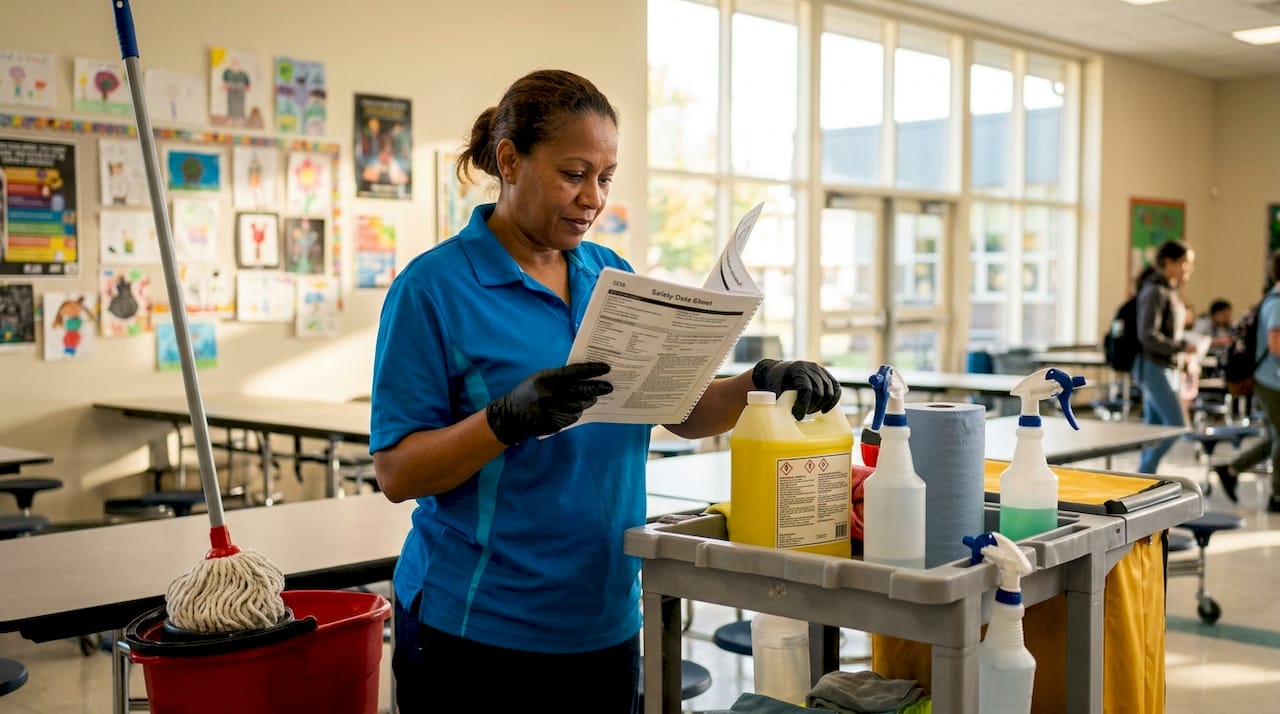
Infection prevention is where school cleaning staff training tips diverge most sharply from general janitorial training. Schools face seasonal pathogen surges, from influenza in the fall to norovirus outbreaks in the winter. Staff need to understand the chain of infection, the difference between cleaning and disinfecting, and which surfaces carry the highest transmission risk. ISSA’s HEHP certification model demonstrates that effective infection control training translates microbiology knowledge into practical cleaning workflows, supported by hands-on practicum and skill verification. That approach builds real competency, not just awareness.
Competency verification separates strong programs from weak ones. Written tests alone do not confirm that a staff member can correctly dilute a disinfectant or properly doff contaminated gloves. In-person assessments and observed practice sessions close that gap.
Here is what a complete training program covers:
- Hazard recognition and job hazard analysis for each school zone
- Correct use and storage of PPE
- Chemical dilution, labeling, and safe disposal procedures
- High-touch surface disinfection protocols
- Seasonal pathogen awareness and outbreak response
- Emergency procedures for spills, exposures, and injuries
- Documentation of completed training with dates and signatures
Pro Tip: Build a site-specific chemical inventory before designing training content. Staff who train on the actual products they use retain procedures far better than those who train on generic examples.
How does ongoing training adapt to changing school environments?
Training is not a one-time event. Infection prevention experts confirm that programs must be ongoing to address seasonal pathogen changes and evolving infection risks in schools. That finding has a direct operational implication: your training calendar should mirror your school year calendar, with refreshers timed to the start of flu season, the return from winter break, and the spring allergy period.
“The goal is to move environmental services teams from support roles to front-line safety partners. That shift requires continuous education, not a single onboarding session. Staff who understand why they are cleaning a surface, not just how, make better decisions in real time.”
Workplace safety training must be regularly reviewed, updated, and documented to maintain a culture of safety and legal compliance. Proactive safety management and incident data tracking improve training effectiveness over time. That means every near-miss, every complaint, and every outbreak investigation should feed back into your training content.
New cleaning technologies also trigger training updates. When a school switches to electrostatic sprayers or introduces a new disinfectant product line, staff need updated instruction before the equipment goes into use. Waiting until after deployment creates compliance risk and increases the chance of improper application.
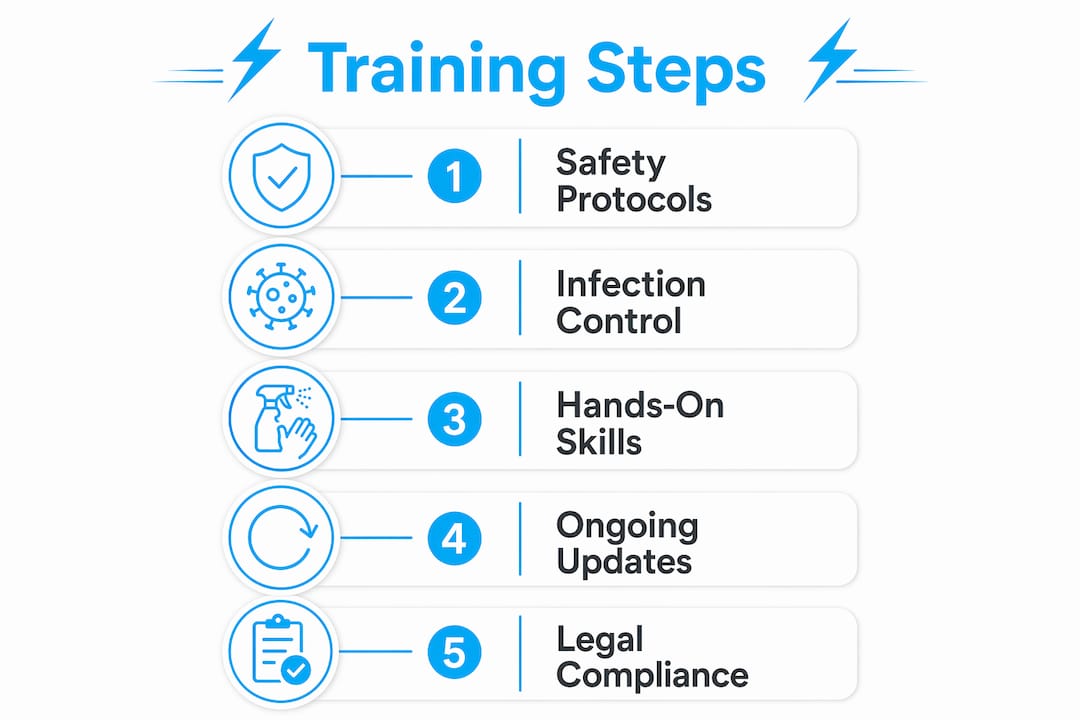
The readiness-for-change concept is worth applying here. Staff who understand the reasoning behind a new protocol adopt it faster and apply it more consistently. Framing training updates as responses to real events, such as a local outbreak or a regulatory change, gives staff context that motivates compliance.
What are the legal and safety compliance expectations for school cleaning staff in Ontario?
Ontario sets clear legal expectations for cleaning staff training, and school administrators carry direct responsibility for meeting them.
Ontario Regulation 297/13 mandates Basic Occupational Health and Safety Awareness Training for all workers, regardless of role. This training is available as a free one-hour online course. Completion is mandatory, not optional, and it applies to every custodial staff member in your school.
That baseline, however, is only the starting point. Due diligence under Ontario law requires supervisors to proactively assess hazards and ensure training matches actual workplace risks. Relying on assumptions about what a staff member learned at a previous job is a compliance risk. Supervisors must be competent, meaning they hold the knowledge, training, and documented experience specific to your facility.
| Compliance requirement | What it means for your school |
|---|---|
| Ontario Regulation 297/13 | All workers complete Basic OHSA Awareness Training |
| Supervisor competency | Supervisors must have site-specific knowledge and documented experience |
| Chemical and equipment verification | Employers must verify training for each product and tool used onsite |
| Training documentation | Records must include dates, content, provider, and worker signatures |
| Job hazard analysis | Site-specific risk assessments must drive training content |
Employers must personally verify that cleaning staff training covers the specific chemicals and equipment used onsite. Assumptions about prior training without verification create direct legal exposure. Documentation is your proof of due diligence in any Ministry of Labour inspection or incident investigation.
Job hazard analyses and worker consultation are required to identify site-specific risks and tailor training accordingly. Generic safety protocols are not sufficient. A school with a commercial dishwasher, a swimming pool, or a science lab has hazards that a standard custodial training program will not address without customization.
Pro Tip: Keep a training binder for each staff member that includes their OHSA awareness certificate, chemical-specific training records, and signed competency assessments. That binder is your first line of defense in any compliance audit.
How does trained cleaning staff improve school health outcomes?
Well-trained cleaning staff contribute directly to safer school environments and better operational outcomes. Reduced infection transmission leads to lower student absenteeism and fewer disruptions to the school year. That connection between cleaning quality and student attendance is well established in environmental hygiene research.
The cleaning staff training benefits extend beyond infection control:
- Consistency: Trained staff follow standardized procedures every time, reducing variability in cleaning quality across classrooms, washrooms, and common areas.
- Confidence: Staff who understand the science behind disinfection make better decisions when conditions change, such as during an outbreak or after a facility renovation.
- Safety culture: A trained custodial team signals to parents, teachers, and students that the school takes health seriously. That perception builds trust and supports broader safety initiatives.
- Reduced errors: Proper chemical training reduces the risk of accidental mixing, overuse, or underuse of disinfectants, all of which compromise both safety and cleaning effectiveness.
- Operational efficiency: Staff who are trained correctly the first time require less retraining and generate fewer incidents that pull supervisors away from other responsibilities.
The role of custodial training in education is most visible during high-risk periods. A school whose staff knows exactly how to respond to a norovirus outbreak, with the right products, the right sequence, and the right PPE, contains the spread far more effectively than one relying on improvised responses.
Key Takeaways
Structured, documented, and site-specific cleaning staff training is the single most effective tool for maintaining school hygiene, meeting Ontario legal requirements, and protecting student health.
| Point | Details |
|---|---|
| Training is a legal requirement | Ontario Regulation 297/13 mandates OHSA Awareness Training for every worker, including custodial staff. |
| Ongoing training is non-negotiable | Seasonal pathogen changes and new equipment require regular refreshers, not a one-time onboarding session. |
| Documentation proves compliance | Training records with dates, content, and signatures protect schools during Ministry of Labour inspections. |
| Site-specific content matters | Job hazard analyses must drive training content; generic protocols do not cover school-specific risks. |
| Trained staff improve health outcomes | Consistent, competency-verified cleaning reduces infection rates and supports a positive school safety culture. |
What I’ve learned from working with school cleaning programs
Most administrators I speak with assume their custodial staff arrived with adequate training. That assumption is the most common compliance gap I see. A staff member may have worked in a school for years and still never received formal instruction on the specific disinfectants your facility uses or the correct dwell time for a high-touch surface protocol. Prior experience is not the same as verified, documented training.
The second pattern I notice is that training gets treated as a budget line item to cut when resources are tight. That decision almost always costs more in the long run. An outbreak investigation, a Ministry of Labour order, or a parent complaint about hygiene standards creates far more disruption than a quarterly training session ever would.
What actually works is integrating training reviews into your regular operational calendar. Tie a training audit to your September back-to-school preparation, your january return from the holiday break, and your spring deep-clean planning. When training updates feel like a normal part of operations rather than an emergency response, staff adopt them without resistance.
Leadership commitment is the variable that separates schools with strong cleaning programs from those that struggle. When administrators treat custodial training as a priority, cleaning teams respond with higher engagement and better results. That relationship between administration and cleaning staff is worth investing in deliberately.
— William
Lightning Cleaning’s approach to school cleaning in Durham Region
Schools in Oshawa, Whitby, Ajax, Pickering, and Clarington trust Lightning Cleaning to deliver trained, compliant custodial services that meet Ontario’s regulatory standards. Our school cleaning services are built around staff who receive ongoing training in infection control, chemical safety, and OHSA compliance, so your facility is protected every day of the school year.
We maintain complete training documentation for every staff member assigned to your school, giving you the records you need for due diligence and regulatory audits. Our programs align with Ontario Regulation 297/13 requirements and go further with site-specific hazard assessments and competency verification. Call Lightning Cleaning at 289-355-9691 for a free on-site quote and a customized cleaning plan built for your school’s needs.
FAQ
What does Ontario law require for school cleaning staff training?
Ontario Regulation 297/13 requires all workers, including custodial staff, to complete Basic OHSA Awareness Training. Employers must also verify site-specific training for every chemical and piece of equipment used onsite.
How often should school cleaning staff receive training updates?
Training should be updated at least seasonally to address changing pathogen risks, and immediately whenever new products, equipment, or regulatory requirements are introduced. Annual refreshers alone are not sufficient for school environments.
What records must schools keep for cleaning staff training?
Schools must maintain records that include training dates, content covered, the provider’s name, and each worker’s signature. These records demonstrate due diligence during Ministry of Labour inspections or incident investigations.
Why is generic cleaning training not enough for schools?
Schools contain site-specific hazards, including science labs, pool areas, and commercial kitchens, that standard custodial training programs do not cover. Job hazard analyses and worker consultation are required to identify and address those risks.
How does cleaning staff training affect student health?
Well-trained cleaning staff reduce infection transmission in schools, which lowers student absenteeism and supports a safer learning environment. Competency-verified staff apply disinfection protocols consistently, which is the key factor in controlling pathogen spread.


