


Cleaning high-touch surfaces in a medical office is defined as the systematic removal of soil, followed by disinfection to inactivate pathogens on surfaces that patients and staff contact repeatedly throughout the day. These surfaces include doorknobs, light switches, examination table handles, countertops, faucet handles, and shared equipment controls. Proper high-touch area cleaning, when executed with Health Canada-registered disinfectants and documented protocols, reduces infection rates by 30–40%. That reduction is not a minor improvement. It represents dozens of prevented infections per year in a busy Durham Region clinic. Ontario’s provincial health authorities and Health Canada both require documented cleaning logs and periodic audits as part of compliance for any medical office.
What tools and products are required for cleaning high-touch surfaces in a medical office?
The right supplies are the foundation of any effective disinfecting protocol for medical office surfaces. Using residential-grade products in a clinical setting is a compliance failure, not just a quality gap.
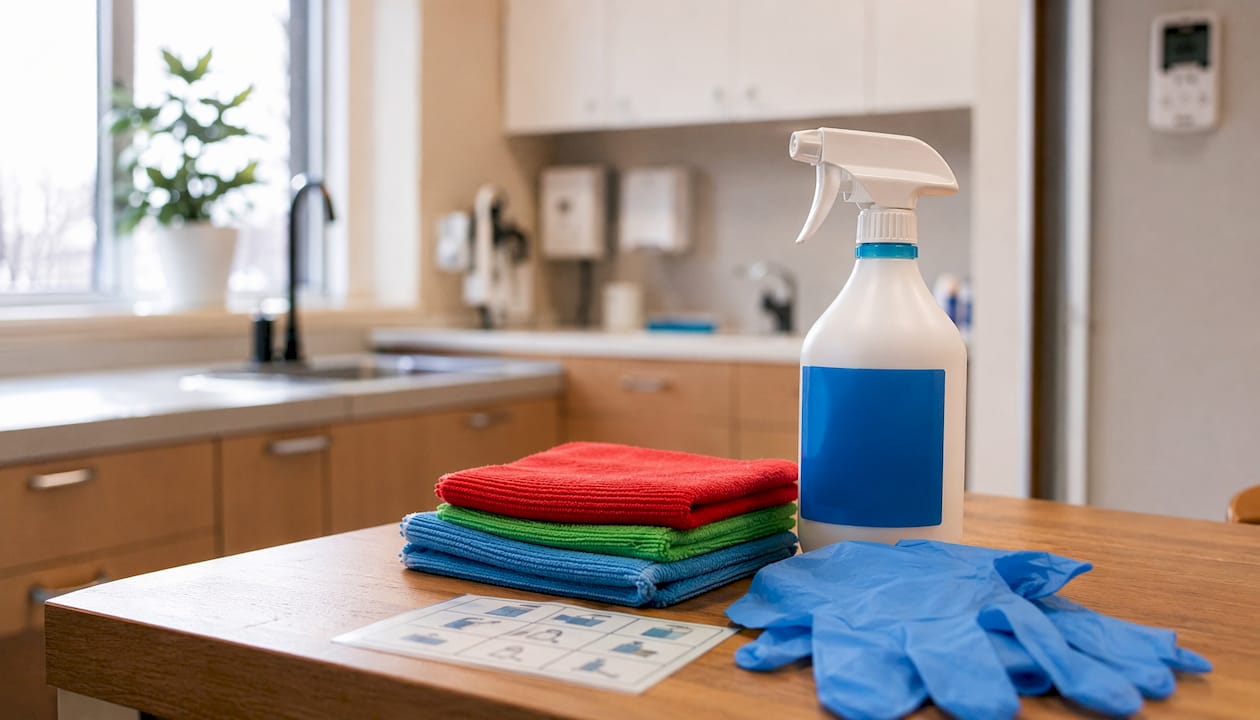
Health Canada-registered disinfectants
Hospital-grade disinfectants with a Drug Identification Number (DIN) issued by Health Canada are required on all patient-contact surfaces in medical offices. The DIN confirms that the product has been tested and approved for pathogen elimination at the concentrations listed on the label. Never substitute a general-purpose cleaner for a DIN-registered disinfectant on clinical surfaces.
Disinfectant contact time (dwell time)
Disinfectant dwell time must be maintained for 1–10 minutes, depending on the product label, for effective pathogen elimination. Wiping a surface dry before that time has elapsed is one of the most common compliance failures in medical offices. The surface must remain visibly wet for the full contact period.
Color-coded microfiber cloth systems
Color-coded microfiber cloths prevent cross-contamination between clinical and non-clinical zones. A standard system assigns red cloths to restrooms, blue to general surfaces, green to food-prep or break areas, and yellow to clinical examination zones. Staff must never use a cloth from one zone in another, regardless of how clean it appears.
PPE and equipment requirements
Cleaning staff must wear gloves, eye protection, and appropriate gowns when handling hospital-grade disinfectants, in line with WorkSafeBC and Ontario occupational health standards. Medical-grade equipment such as microfiber mop systems and HEPA-filtered vacuums differ significantly from residential tools in both durability and contamination control.
| Supply | Purpose | Compliance note |
|---|---|---|
| DIN-registered disinfectant | Pathogen inactivation on contact surfaces | Required by Health Canada |
| Color-coded microfiber cloths | Zone-specific cleaning, cross-contamination prevention | CPSBC environmental cleaning standard |
| Disposable gloves and eye protection | Staff safety during disinfectant application | WorkSafeBC PPE requirement |
| HEPA-filtered vacuum | Particulate removal without airborne spread | Medical-grade equipment standard |
| Spray bottles (labeled by zone) | Controlled disinfectant application | Prevents product misuse |
Pro Tip: Always check the disinfectant label for the specific dwell time against the pathogens you are targeting. A product effective against MRSA may require a longer contact time than one targeting influenza.
How often should high-touch surfaces be cleaned in a medical office?
Cleaning frequency is not a single answer. It depends on the zone, patient volume, and the type of activity in each area.
Medical offices with 20–30 daily patients require 4–6 cleaning cycles during operating hours to maintain safe surface conditions. That frequency applies specifically to examination rooms and high-traffic clinical zones. Administrative areas and private offices operate on a different schedule.
A practical daily cleaning schedule for a busy medical office looks like this:
- Pre-opening sweep. Wipe all high-touch surfaces in waiting areas, reception counters, and restrooms before the first patient arrives.
- Mid-morning cycle. Clean examination rooms between patient encounters. Disinfect all contact surfaces including the examination table, handles, and any shared equipment.
- Midday deep wipe. Focus on waiting room chairs, door handles, and restroom fixtures. Restrooms in busy clinics require cleaning every 2–4 hours.
- Afternoon cycle. Repeat examination room protocol between afternoon patients. Check and restock hand sanitizer dispensers.
- Post-clinic clean. Full disinfection of all clinical surfaces, restrooms, and waiting areas after the last patient.
- End-of-day log. Record all cleaning activities, products used, and staff signatures before closing.
Cleaning frequency also varies by office size and patient volume, so smaller practices may consolidate some cycles while larger clinics may need to add them.
Seasonal adjustments matter too. During peak respiratory illness seasons, cleaning intensity must increase in waiting areas and on shared surfaces. In Ontario, that means heightened protocols from october through march, when flu and respiratory virus transmission peaks.
Pro Tip: Post a visible cleaning log in each examination room. Patients notice it, and it reinforces confidence in your facility’s safety standards.
What is the correct step-by-step protocol for disinfecting medical office surfaces?
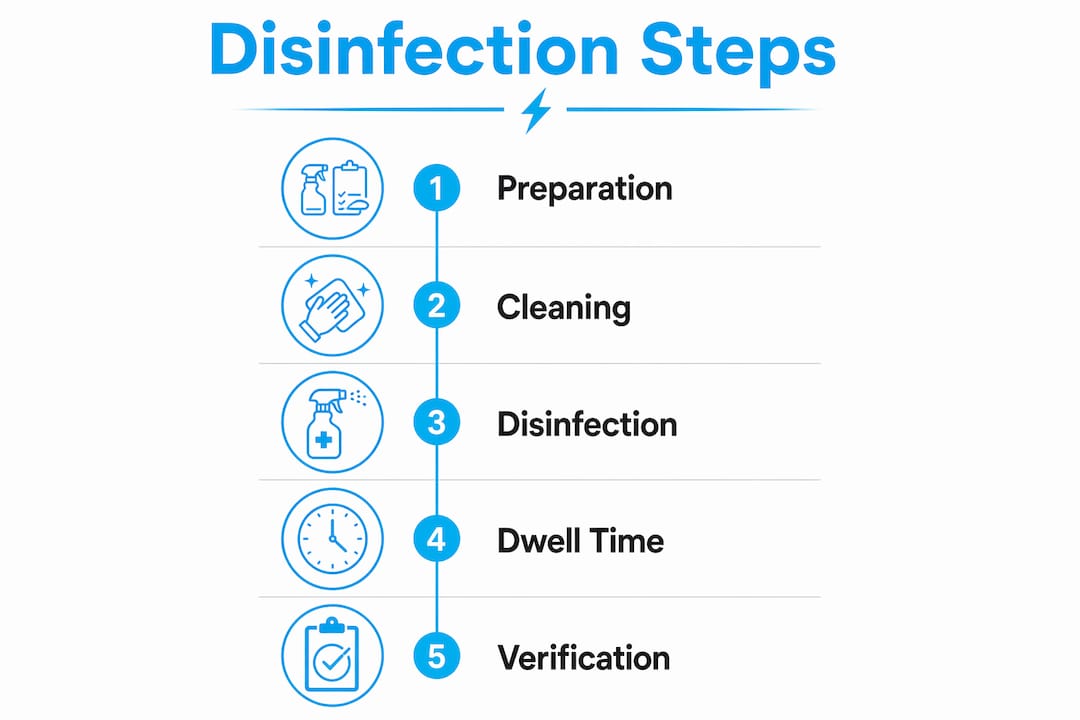
Effective sanitizing of surfaces in healthcare settings follows a two-stage process. Cleaning removes visible soil and debris. Disinfection then inactivates the pathogens that remain. Cleaning must precede disinfection for the disinfectant to work. Applying a disinfectant to a dirty surface reduces its effectiveness significantly.
Stage 1: Surface cleaning
- Remove all visible debris, organic matter, and dust using a damp microfiber cloth with a detergent solution.
- Use mechanical action (scrubbing) on textured surfaces such as examination table edges and sink fixtures.
- Dispose of single-use cloths immediately. Place reusable cloths in the correct color-coded laundry bag.
- Never dry-dust clinical surfaces. Dry dusting spreads particles rather than removing them.
Stage 2: Disinfection
- Apply a Health Canada DIN-registered disinfectant to the cleaned surface using a spray bottle or pre-saturated wipe.
- Allow the surface to remain visibly wet for the full dwell time listed on the product label.
- Do not wipe the surface dry before the dwell time is complete. This is the single most common compliance failure in medical office cleaning.
- After the dwell time, allow the surface to air dry or wipe with a clean cloth if the product label permits.
Stage 3: Verification
ATP bioluminescence testing verifies surface cleanliness at a threshold below 250 RLU. Any reading above that threshold indicates residual contamination and requires re-cleaning. ATP testing is the most objective post-cleaning verification method available to facility managers.
| Technique | Method | Verification |
|---|---|---|
| Manual surface cleaning | Damp microfiber cloth with detergent, mechanical scrubbing | Visual inspection for soil removal |
| Disinfectant application | DIN-registered product, spray or pre-saturated wipe | Dwell time confirmed on label |
| Post-cleaning verification | ATP bioluminescence test | Reading below 250 RLU confirms compliance |
Pro Tip: Keep a laminated dwell-time reference card at each cleaning station. Staff should not rely on memory for contact times, especially when switching between disinfectant products.
How do you maintain and document cleaning compliance in a medical office?
Documentation is the proof that your protocols are working. Without it, a medical office cannot demonstrate compliance during a provincial health authority inspection.
Cleaning logs must record the date, time, cleaning agents used, contact times, and staff signatures for every cleaning cycle. Medical directors bear direct responsibility for maintaining these records for at least 3 years. A missing log entry is treated the same as a missed cleaning during an inspection.
Best practices for documentation and verification:
- Use a standardized log sheet for each zone (examination rooms, restrooms, waiting areas, administrative spaces).
- Record the specific disinfectant product name and DIN number for each cleaning cycle.
- Document ATP test results after each deep cleaning session.
- Maintain staff training records showing that each cleaner has been trained on current protocols.
- Log PPE use and any incidents involving chemical exposure.
- Schedule internal audits quarterly and external third-party inspections annually.
- Update cleaning protocols annually or whenever Health Canada or Ontario public health guidelines change.
Ontario’s provincial health regulations require that medical office compliance records be available for review at any time during a health authority inspection. Facilities that cannot produce current logs face operational consequences.
Pro Tip: Digital logbook platforms allow staff to log cleaning cycles from a tablet in real time. They also generate automatic audit trails, which removes the risk of lost paper records before an inspection.
Key Takeaways
Cleaning high-touch surfaces in a medical office requires Health Canada-registered disinfectants, correct dwell times, color-coded microfiber systems, and documented logs maintained for at least 3 years.
| Point | Details |
|---|---|
| Use DIN-registered disinfectants | Only Health Canada-approved products with a Drug Identification Number meet clinical surface standards. |
| Respect disinfectant dwell time | Surfaces must stay visibly wet for 1–10 minutes; wiping early renders disinfection ineffective. |
| Follow a zone-based cleaning schedule | Examination rooms need 4–6 cycles daily; restrooms need cleaning every 2–4 hours. |
| Verify with ATP testing | Post-cleaning ATP readings below 250 RLU confirm effective surface disinfection. |
| Document every cleaning cycle | Logs with dates, products, contact times, and signatures must be kept for at least 3 years. |
Why most medical offices underestimate the compliance gap
I have worked with facility managers across Durham Region who run tight, well-intentioned operations. The gap I see most often is not laziness. It is a misunderstanding of what “clean” actually means in a clinical context.
The most common failure I observe is dwell time. Staff spray a surface, wipe it immediately, and move on. The surface looks clean. The disinfectant label says it kills 99.9% of pathogens. But if the product never had 3 minutes of contact time, that claim does not apply. The surface is not disinfected. It is just wet and then dry.
The second failure is documentation. A clinic can have excellent cleaning habits and still fail an inspection because the logs are incomplete or missing. Inspectors do not observe your daily routine. They read your records. If the records do not exist, the cleaning did not happen in regulatory terms.
The third failure is seasonal adjustment. Facilities that run the same protocol in july as they do in january are not accounting for the real-world spike in respiratory pathogens during Ontario winters. Protocols must adapt, and that adaptation must be documented.
The fix for all three is straightforward: train staff on dwell time until it is a reflex, adopt digital logs that cannot be lost, and build a seasonal protocol review into your annual calendar. Professional cleaning services that specialize in medical facilities bring all three of these disciplines as standard practice.
— William
Lightning Cleaning’s medical facility cleaning services in Durham Region
Medical offices in Oshawa, Whitby, Ajax, Pickering, and Clarington trust Lightning Cleaning for daily disinfection of high-touch surfaces using Health Canada-registered, DIN-approved products. Our trained staff follow documented protocols aligned with Ontario provincial health standards, and we provide cleaning logs that support your facility’s audit readiness.
Lightning Cleaning’s medical facility cleaning program covers examination rooms, waiting areas, restrooms, and administrative spaces on schedules built around your patient volume. We also offer specialized cleaning services for facilities with higher-intensity requirements. Call 289-355-9691 today for a free on-site quote and find out how we can keep your medical office compliant and safe.
FAQ
What are high-touch surfaces in a medical office?
High-touch surfaces in a medical office include doorknobs, light switches, examination table handles, countertops, faucet handles, shared equipment controls, and reception desk surfaces. These areas require disinfection multiple times per day because they contact many patients and staff members.
How long does disinfectant need to stay on a surface to work?
Disinfectant dwell time ranges from 1–10 minutes depending on the product and the target pathogen. The surface must remain visibly wet for the full contact period listed on the product label.
How do I verify that surfaces are properly disinfected?
ATP bioluminescence testing measures surface cleanliness objectively. A reading below 250 RLU confirms effective disinfection. Use ATP testing after deep cleaning sessions and during internal audits.
How often should examination rooms be cleaned in a busy clinic?
Examination rooms in medical offices with 20–30 daily patients require 4–6 cleaning cycles during operating hours, plus a full disinfection after the last patient of the day.
What records does a medical office need to keep for cleaning compliance?
Cleaning logs must record the date, time, products used, contact times, and staff signatures for every cleaning cycle. Ontario health regulations require these records to be retained for at least 3 years and available for inspection at any time.


