


For most Canadian facilities, the best commercial entrance mats by use-case break down like this:
- Heavy-duty exterior scraper: Dura-Scraper Checkered Rubber Doormat or Dura-Scraper Drainage Mat — aggressive surface patterns dislodge coarse grit and channel snow-melt away from foot traffic.
- Vestibule wiper-scraper: Ultra Scraper commercial doormat or Door Scraper commercial entrance mats — built for the transition zone between outside and inside, where both scraping and initial moisture removal matter.
- Interior absorbent walk-off: Nottingham rubber-backed carpet mat, Wellington rubber-backed carpet mats, or Grime Fighter carpet mats — textile pile absorbs residual moisture and fine soil before it reaches your floors.
- Recessed permanent installation: Base Specialties aluminum entrance grid/grilles — the right call for large lobbies and storefronts with heavy wheeled traffic.
- Eco-conscious scraper: VersaTex Multi-Purpose Recycled Rubber Floor Mat — recycled-rubber construction for facilities with sustainability targets.
- Professional mat maintenance: Lightning Cleaning — on-site extraction and documented condition reporting for Durham Region facilities that want to extend mat life rather than replace frequently.
Two standards matter most in Canada: ANSI/NFSI B101.6 governs matting performance and transition safety, and Health Canada’s flammability rules apply to any textile mat exceeding 2.16 m² or 1.8 m in linear dimension. Request documentation for both before you finalize a purchase.
Table of Contents
- How do the best commercial entrance mats compare side by side?
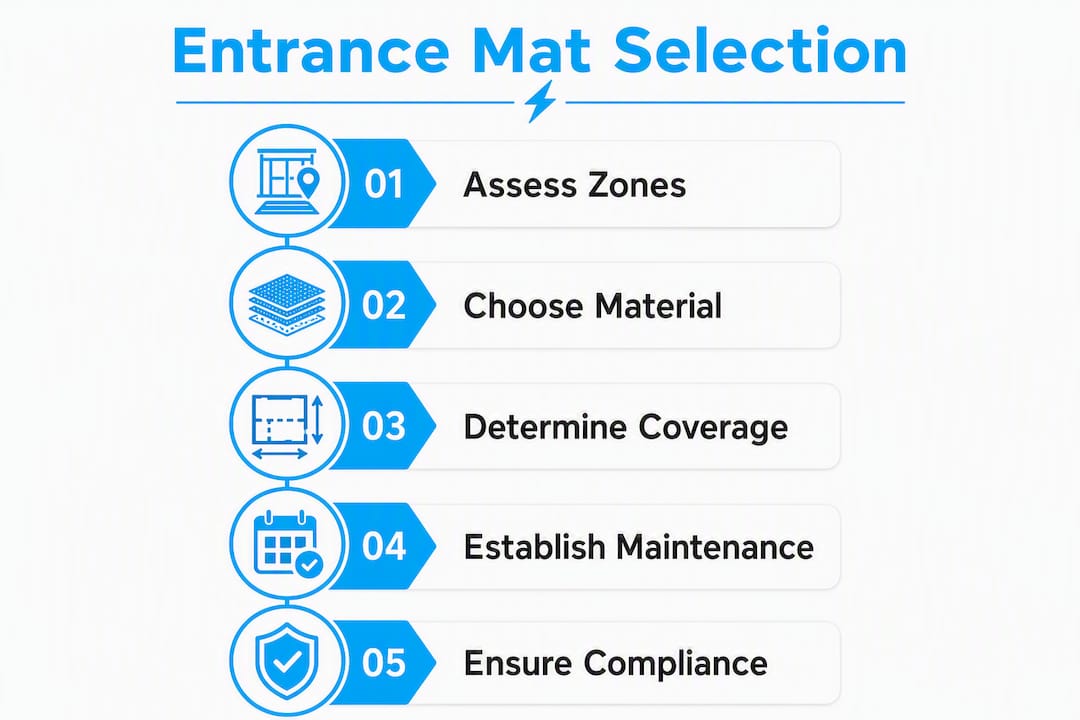
- How to choose the right commercial entrance mat for your building
- What material should you choose for your entrance mat?
- How much matting does your entrance actually need?
- Cleaning schedules and realistic lifespan for commercial mats
- Canadian safety and compliance: what standards apply to your mats?
- Why the tiered system and 12–15 ft coverage actually work
- Key Takeaways
- A facility manager’s honest view on entrance mats in Durham Region
- Lightning Cleaning keeps your mats performing between replacements
- Useful sources and standards
- FAQ
How do the best commercial entrance mats compare side by side?
The table below covers the 17 mat products and one service option featured in this guide. Lightning Cleaning leads as the publisher’s featured option; remaining rows follow in substance order.
| Product | Best For | Material | Durability / Lifespan | Maintenance | Indoor / Outdoor | Installation |
|---|---|---|---|---|---|---|
| Lightning Cleaning (service) | Facilities extending mat life via scheduled professional servicing | N/A — service | Extends mat life beyond typical replacement cycle | On-site extraction, condition reports, quarterly inspections | Both | On-site service |
| Base Specialties aluminum entrance grid/grilles | Large lobbies, heavy wheeled traffic, permanent recessed systems | Aluminum grid | 10+ years with proper care | Hose-down, debris removal | Indoor (recessed) | Recessed well |
| Grime Fighter carpet mats | Very high-traffic lobbies needing heavy soil retention | Engineered textile pile | 3–5 years commercial grade | Vacuum daily; hot-water extraction | Indoor | Surface |
| Ultra Scraper commercial doormat | Industrial and high-traffic retail entries | Durable scraper compound | 3–5 years | Shake out, hose down | Indoor / outdoor | Surface |
| Dura-Scraper Drainage Mat | Entrances exposed to snow-melt and slush | Rubber with drainage channels | 3–5 years | Hose down, air dry | Outdoor | Surface |
| Dura-Scraper Checkered Rubber Doormat | Exterior high-debris entrances | Rubber (checkered pattern) | 3–5 years | Hose down | Outdoor | Surface |
| Nottingham rubber-backed carpet mat | Interior vestibule absorbency with stable backing | Textile pile / rubber backing | 2–4 years | Vacuum; launder or extract | Indoor | Surface |
| Wellington rubber-backed carpet mats | Office and hospitality vestibules | Textile pile / rubber backing | 2–4 years | Vacuum; launder or extract | Indoor | Surface |
| Dura-Scraper Linear Rubber Doormat | High-traffic exterior thresholds, directional footfall | Rubber (linear ribs) | 3–5 years | Hose down | Outdoor | Surface |
| Dura-Scraper Wave Rubber Door Mat | Mixed interior/exterior use | Rubber (wave pattern) | 3–5 years | Hose down | Indoor / outdoor | Surface |
| Chevron rib carpet matting | Interior walk-off lanes needing directional drying | Ribbed textile | 2–4 years | Vacuum; extract | Indoor | Surface |
| GORILLA GRIP Waterproof Traffic Guard Door Mat | Small retail entries, utility zones | Rubber with waterproof backing | 2–3 years | Hose down | Indoor / outdoor | Surface |
| VersaTex Multi-Purpose Recycled Rubber Floor Mat | Eco-conscious facilities, moderate traffic | Recycled rubber | 2–4 years | Hose down | Indoor / outdoor | Surface |
| Cairo rubber coir mat | Exterior entries where aesthetics matter | Coir fiber / rubber backing | 1–3 years | Shake out; hose down | Outdoor | Surface |
| Soft Top olefin commercial door mats | Office entries, moderate traffic | Olefin pile | 2–3 years | Vacuum; spot clean | Indoor | Surface |
| Door Scraper commercial entrance mats | Basic exterior scraping, cost-priority | Rubber scraper compound | 2–4 years | Hose down | Outdoor | Surface |
| Ribbed polypropylene carpet mats | Budget interior walk-off | Polypropylene | 1–3 years | Vacuum; hose down | Indoor | Surface |
A few notes on the products that warrant more than a table row:
Base Specialties aluminum entrance grid/grilles stand apart from every other option on this list because they are a permanent infrastructure investment, not a replaceable mat. Recessed into a floor well, they handle heavy wheeled carts, pallet jacks, and thousands of daily foot contacts without curling edges or backing delamination. They are the correct specification for large retail lobbies, hospital main entrances, and any facility where a surface-mounted mat would create a trip hazard or shift under heavy traffic.
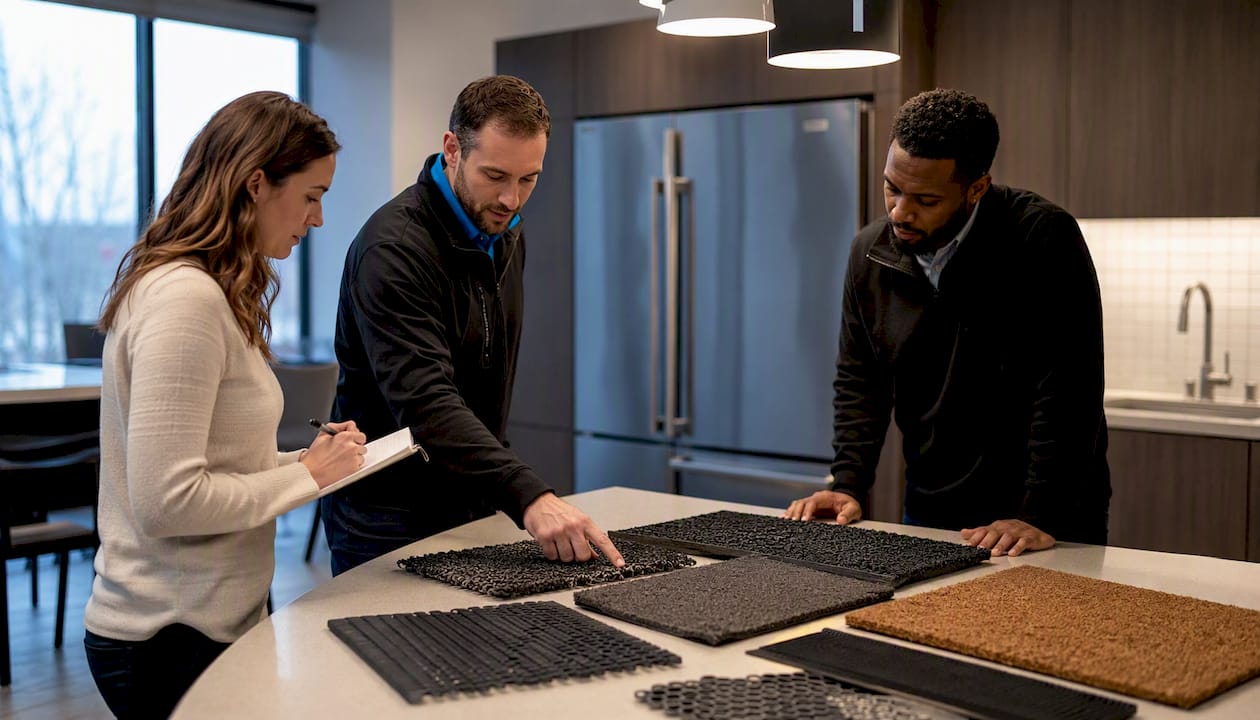
Grime Fighter carpet mats are engineered specifically for soil retention at volume. The pile construction holds fine particulate and moisture well past the point where a standard ribbed mat would transfer soil back onto shoe soles. For a busy Durham Region office building or school, these are worth the higher unit cost.
VersaTex Multi-Purpose Recycled Rubber Floor Mat is the only option here built from post-consumer recycled rubber. If your facility reports on environmental metrics or holds a green building certification, this mat gives you a documented sustainability claim without sacrificing scraper performance.
Cairo rubber coir mat is the one product on this list where natural fiber is the point. Coir scrapes aggressively and looks appropriate at a professional entrance, but it degrades faster in prolonged wet conditions. Use it at covered exterior entries, not exposed to direct rain or snow accumulation.
Ribbed polypropylene carpet mats are the budget option. They work for low-to-moderate interior traffic, clean easily, and cost less than textile alternatives. The trade-off is a shorter lifespan and lower soil-holding capacity.
How to choose the right commercial entrance mat for your building
Start with traffic volume and weather exposure before you look at any product spec sheet. A mat that performs well in a 200-person office building in Ajax will be saturated and ineffective within days at a 1,000-person distribution center in Whitby.
Priority criteria:
- Traffic volume: High-traffic entries (500+ daily contacts) need commercial-grade pile depth, nitrile or rubber backing, and a servicing schedule tied to foot count, not a fixed calendar.
- Weather exposure: Canadian winters bring slush, road salt, and freeze-thaw cycles. Exterior mats need drainage channels or open-grid construction. Interior vestibule mats need absorbent pile that can be laundered or extracted frequently.
- Soil type: Coarse grit and gravel call for aggressive scraper ribs. Fine dust and moisture call for dense textile pile. Most Canadian entrances need both, which is why a single mat rarely suffices.
- Mat zone role: Identify whether you need an exterior scraper, a vestibule wiper-scraper, or an interior walk-off mat. Each zone has a different functional requirement.
- Maintenance capacity: If your team cannot launder or extract mats weekly during peak seasons, choose a mat with drainage channels and a hose-down cleaning method. Textile mats that sit wet become hygiene and slip hazards.
- Transition and ADA concerns: Beveled edges (typically 3/8" or less rise) prevent trip hazards at mat edges. ANSI/NFSI B101.6 requires safe transitions as part of matting performance compliance.
- Slip resistance: Request the Static Coefficient of Friction (SCOF) data from any vendor. Mats that pass third-party slip testing under wet conditions are the only ones worth specifying in a commercial facility.
Vendor questions to ask before you buy:
- What is the mat’s backing material — nitrile rubber, natural rubber, or vinyl?
- Is the mat launderable, and at what temperature?
- What is the recommended coverage length for our traffic volume?
- Do you have third-party slip-test reports available?
- What is the warranty, and does it cover backing delamination?
- Can the mat be customized with a logo, and does customization affect flammability compliance?
Red flags: thin consumer vinyl backing that curls at edges; no beveled edge profile; no slip-resistance data available from the vendor; mats sold without installation or anchoring guidance.
What material should you choose for your entrance mat?
Material choice determines how a mat performs across its entire service life. Here is how each category breaks down for Canadian commercial facilities:
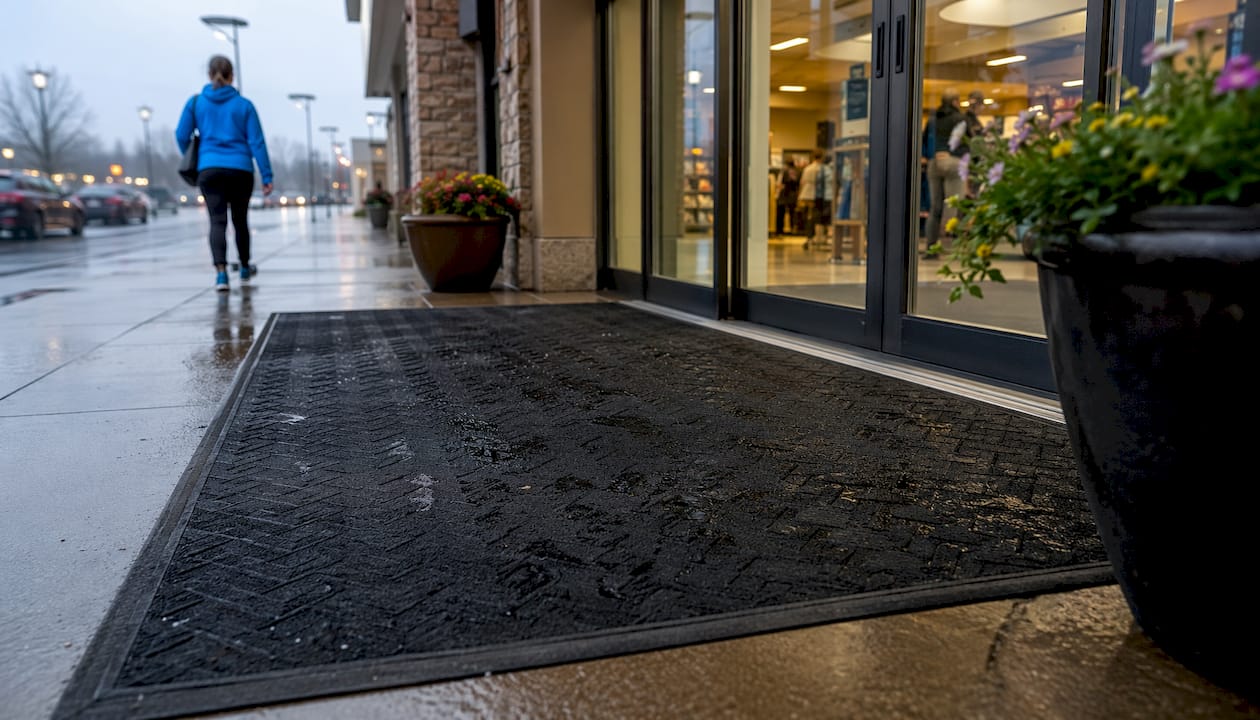
Rubber is the workhorse for exterior scraper zones. It handles freeze-thaw cycles, road salt, and heavy foot traffic without degrading quickly. Nitrile rubber backing on interior mats resists oil and chemical migration better than natural rubber. The Dura-Scraper product line (Checkered, Linear, Wave, Drainage) covers the main rubber scraper configurations. Drainage-channel variants are specifically engineered for slush and snow-melt conditions common from November through March in Durham Region.
Aluminum grid/grilles (Base Specialties) are the highest-durability option and the only one suited to wheeled traffic. They require a recessed floor well, which means they are a construction or renovation decision, not a quick purchase. The payoff is a 10-plus-year service life with minimal maintenance beyond periodic debris removal.
Textile pile (nylon, olefin, polypropylene) handles the interior walk-off function. Nylon holds more soil per square foot than olefin and launders well. Olefin (used in Soft Top olefin commercial door mats) dries faster and resists moisture absorption, which is useful in vestibules where mats stay damp. Polypropylene (Ribbed polypropylene carpet mats) is the economy option: easy to clean, shorter lifespan. Grime Fighter carpet mats use an engineered pile specifically for high soil-retention capacity.
Coir (Cairo rubber coir mat) is a natural plant fiber with good scraping action and a professional appearance. It degrades faster than rubber or nylon in wet conditions and is best suited to covered exterior entries.
Recycled rubber (VersaTex) performs similarly to virgin rubber for scraping but carries a sustainability credential. For facilities tracking environmental metrics, this is the straightforward choice for moderate-traffic scraper zones.
Pro Tip: Solution-dyed yarns in textile mats resist fading and bleaching from cleaning chemicals far better than surface-dyed alternatives. Ask your vendor specifically whether the pile is solution-dyed before specifying a mat for a high-visibility lobby.
Industry guidance consistently shows that backing type is the single biggest predictor of lifespan and trip-hazard risk. Nitrile or thick rubber backings resist curling and edge migration; thin vinyl backings do not.
How much matting does your entrance actually need?
A single mat at the door is almost never enough for a commercial facility. The three-zone model is the operational standard: Zone 1 (exterior scraper), Zone 2 (vestibule wiper-scraper), and Zone 3 (interior walk-off). Each zone captures a different soil fraction, and together they protect your interior floors.
| Zone | Role | Recommended Coverage | Suitable Products |
|---|---|---|---|
| Zone 1 — Exterior scraper | Remove coarse grit, gravel, and snow | Minimum 3–4 ft | Dura-Scraper Checkered, Drainage Mat, Cairo coir, Door Scraper |
| Zone 2 — Vestibule wiper-scraper | Remove residual grit and initial moisture | Minimum 4–5 ft | Ultra Scraper, Dura-Scraper Wave/Linear, GORILLA GRIP |
| Zone 3 — Interior walk-off | Absorb residual moisture and fine soil | Minimum 5–6 ft | Nottingham, Wellington, Grime Fighter, Chevron rib, Soft Top |
| Combined total | Full soil and moisture capture | 12–15 ft | Tiered system |
Industry guidance recommends a combined matting depth of 12–15 feet across all zones for effective soil and moisture capture at high-traffic commercial entrances.
Industry guidance recommends a combined matting depth of 12–15 feet for effective soil and moisture capture at high-traffic commercial entrances, especially for Durham Region facilities dealing with heavy winter conditions, where it is best to err toward the upper end of that range from November through April.
Installation checklist:
- Confirm floor well dimensions before ordering recessed aluminum grids.
- Specify beveled edges on all surface-mounted mats (3/8" maximum rise).
- Use anti-slip anchoring tape or gripper backing on smooth tile or polished concrete.
- Choose modular tile systems for irregular or curved entry openings where standard mat sizes do not fit cleanly.
- Leave no gap between Zone 1 and Zone 2 mats — gaps collect debris and create trip hazards.
Cleaning schedules and realistic lifespan for commercial mats
A commercial-grade mat maintained properly lasts significantly longer than most consumer-grade mats in the same location. The difference is backing quality, pile density, and — critically — how often the mat is serviced.
Maintenance schedule by traffic level:
- Daily (all traffic levels): Shake out or vacuum pile mats. Remove visible debris from scraper mats.
- Weekly (moderate traffic, 200–500 daily contacts): Vacuum pile mats thoroughly. Hose down rubber scraper mats and allow to dry completely before redeployment.
- 2–3 times per week (high traffic, 500+ daily contacts): Vacuum pile mats. Rotate mats if you carry spares. Check edges for curling or delamination.
- Monthly or as needed: Hot-water extraction for pile mats. Hot-water extraction is the gold standard for restoring soil-holding capacity and hygiene in textile mats.
- Quarterly: Full condition inspection. Document pile wear, backing integrity, and edge condition. Replace any mat showing backing delamination, pile loss exceeding 30%, or persistent saturation.
Replacement triggers: backing that curls or migrates; pile worn flat in the traffic lane; mat that cannot be dried within a reasonable time after laundering; edges that cannot be re-beveled or anchored safely.
Pro Tip: To check saturation quickly, lift the mat and compare the floor beneath to the adjacent unprotected floor. If both surfaces show equal soil levels, the mat is saturated and needs immediate laundering or replacement. A mat that is still capturing soil will leave the floor beneath noticeably cleaner.
Regular professional cleaning extends mat life and is often more cost-effective than frequent replacement, particularly for high-pile textile mats that respond well to extraction.
Canadian safety and compliance: what standards apply to your mats?
Two regulatory frameworks apply directly to commercial entrance mats in Canada.
| Standard / Regulation | What It Covers | When It Applies |
|---|---|---|
| ANSI/NFSI B101.6 | Selection, installation, inspection, care, and maintenance of entrance mats to reduce slips, trips, and falls | All commercial facilities; governs transition safety and SCOF requirements |
| Health Canada — Hazardous Products (Carpet) Regulations | Flammability requirements for textile floor coverings | Any textile mat exceeding 2.16 m² (24 ft²) or 1.8 m (6 ft) in any linear dimension |
Documentation to request from every vendor:
- Third-party slip-test report (SCOF values under wet and dry conditions)
- Material datasheet confirming backing type and composition
- Flammability compliance certificate for any large textile mat
- Warranty terms, specifically covering backing delamination and pile separation
- Installation guide including anchoring and transition specifications
Practical safety notes:
- Beveled edges are not optional in commercial settings. An unbeveled mat edge is a documented trip hazard.
- Cleaning chemicals tracked onto mat surfaces can temporarily reduce SCOF. Schedule mat cleaning outside peak traffic hours.
- Recessed aluminum grid wells must be flush with the surrounding floor. Any lip or depression creates a wheel-catch hazard for carts and mobility devices.
- For medical facilities and schools in Durham Region, mat hygiene documentation may be reviewed during compliance audits. Include mat inspection clauses in your service scope of work.
Why the tiered system and 12–15 ft coverage actually work
The evidence behind the zone model is straightforward. A well-designed matting program can trap up to 80% of the dirt tracked into a building, and over 80% of interior soil enters through doorways. That means the entrance is where the majority of your floor protection budget should be concentrated.
The 12–15 ft combined coverage recommendation works because each zone captures a different particle size and moisture fraction. Zone 1 removes the bulk of coarse grit before it reaches the building interior. Zone 2 catches residual grit and begins moisture removal. Zone 3 absorbs the fine soil and moisture that survive the first two zones. A single mat at the door handles only the first fraction of that capture sequence.
How to apply this at your facility:
- Measure your current matting depth from the exterior door to the last mat edge. If you are under 10 feet, you are leaving significant soil capture on the table.
- Walk the entry after a rain or snow event. If you see soil transfer beyond the mat edge, your coverage is insufficient.
- For a small retail entry (one door, 100–200 daily contacts), a 4 ft exterior scraper plus a 6 ft interior walk-off mat covers the minimum. For a large supermarket or school with multiple entry doors and 1,000+ daily contacts, each door should have the full 12–15 ft tiered system.
- Check mat saturation weekly during winter months in Durham Region. Slush and road salt accelerate saturation and can damage textile pile if mats are not extracted promptly.
A matting program that captures 80% of tracked-in soil at the entrance reduces interior floor cleaning frequency and extends floor finish life significantly. — Opora Supply field guide
Key Takeaways
The most effective commercial entrance mat program uses a tiered three-zone system sized to 12–15 feet of combined coverage, along with scheduled professional maintenance to protect both mat life and interior floors.
| Point | Details |
|---|---|
| Zone first, then product | Specify exterior scraper, vestibule wiper-scraper, and interior walk-off before choosing any product. |
| Size to 12–15 ft combined | Industry guidance recommends a combined matting depth of 12–15 feet for effective soil and moisture capture. |
| Backing quality determines lifespan | Nitrile or thick rubber backings resist curling and delamination; thin vinyl backings are a liability risk in commercial settings. |
| Maintain by foot count, not calendar | High-traffic entries (500+ daily contacts) need extraction 2–3 times per week during peak seasons, not monthly. |
| Lightning Cleaning for local mat care | Lightning Cleaning provides on-site extraction and documented condition reporting for Durham Region facilities — an alternative to frequent mat replacement. |
A facility manager’s honest view on entrance mats in Durham Region
Most facility managers do not think about entrance mats until something goes wrong: a slip incident, a floor finish that is failing faster than expected, or a mat that has curled into a trip hazard overnight. By then, the cost is already higher than it needed to be.
What actually matters in day-to-day operations is predictability. You need to know that your mats will perform through a Durham Region winter — from the first November slush through the spring thaw in April — without requiring emergency replacements or creating liability exposure. That means specifying the right material for each zone, sizing coverage to at least 12 feet, and building a maintenance schedule before the season starts, not after the first incident.
The seasonal context here is real. Oshawa, Whitby, Ajax, and Pickering all see significant road salt and slush tracked through commercial entries from late fall through early spring. Rubber scraper mats in Zone 1 take the worst of it. Textile walk-off mats in Zone 3 absorb the residual moisture. Both need more frequent servicing during those months than the rest of the year.
One practice worth adding to your service scope of work: require written mat condition reports at every quarterly inspection. If a mat develops an edge trip hazard, you want that documented and reported within 24 hours. That documentation protects you during insurance or liability reviews in a way that a verbal report never will.
Lightning Cleaning keeps your mats performing between replacements
Choosing the right mat is only half the equation. A Grime Fighter carpet mat or a Nottingham rubber-backed mat that is never properly extracted will saturate, lose soil-holding capacity, and fail years before its rated lifespan. That is where scheduled professional maintenance changes the math.
Lightning Cleaning provides on-site mat extraction and scheduled maintenance for commercial facilities across Durham Region, including Oshawa, Whitby, Ajax, Pickering, and Clarington. The service includes hot-water extraction, documented condition reporting, and quarterly inspections — so your facility manager always has a written record of mat status. For offices, schools, medical clinics, and industrial sites, that documentation matters both for compliance and for budgeting replacement cycles accurately.
If your facility is managing multiple entry points or high-traffic zones, a scheduled mat program through Lightning Cleaning typically costs less over a two-to-three-year period than replacing mats that failed prematurely due to inadequate servicing. We also offer floor waxing and carpet cleaning to protect the interior floors your mat program is designed to defend.
Call 289-355-9691 for a free on-site quote. We will assess your entry zones, recommend a servicing frequency tied to your actual foot traffic, and give you a written program proposal.
Useful sources and standards
- Industry Guide to Canadian Requirements for Carpets and Textile Floor Coverings — Canada.ca — plain-language Health Canada guide covering which mats require flammability compliance.
Request third-party slip-test reports and vendor installation guides from any supplier before finalizing a specification. If a vendor cannot provide SCOF data, that is a clear signal to look elsewhere.
FAQ
What is the best material for a commercial entrance mat?
For most Canadian facilities, a combination of rubber (exterior scraper zone) and nylon or olefin textile pile (interior walk-off zone) delivers the best overall performance. Rubber handles coarse grit and moisture in outdoor conditions; nylon pile absorbs residual moisture and fine soil before it reaches interior floors.
How much matting does a commercial entrance need?
Industry guidance recommends a combined matting depth of 12–15 feet across all three zones (exterior scraper, vestibule wiper-scraper, interior walk-off) for high-traffic commercial entrances. A single mat at the door is rarely sufficient.
What slip-resistance standard applies to commercial entrance mats in Canada?
ANSI/NFSI B101.6 is the relevant standard, covering selection, installation, inspection, and maintenance of entrance mats to reduce slips, trips, and falls. Request third-party SCOF test data from any vendor before purchasing.
When do Health Canada flammability rules apply to entrance mats?
Health Canada’s flammability requirements apply to any textile mat exceeding 2.16 m² (24 ft²) or 1.8 m (6 ft) in any linear dimension. Large logo mats and custom walk-off mats commonly exceed these thresholds and require compliance documentation.
How often should commercial entrance mats be professionally cleaned?
Servicing frequency should be tied to foot traffic, not a fixed calendar. High-traffic entries (500+ daily contacts) typically need hot-water extraction 2–3 times per week during peak seasons. Signs that a mat needs professional cleaning include visible soil transfer beyond the mat edge, persistent dampness, and pile that no longer springs back after foot contact.


