


If your commercial property is busy during operating hours, day porter services are one of the most direct ways to keep it clean, safe, and presentable without pulling your own staff away from core work. Call Lightning Cleaning at 289-355-9691 for a free on-site quote in Durham Region.
A day porter handles visible, real-time maintenance while your building is occupied: lobby upkeep, restroom checks, spill response, touchpoint disinfection, trash rounds, and conference-room resets. Unlike an after-hours janitorial crew, a porter is on site when it matters most — during business hours, in front of clients, tenants, and staff.
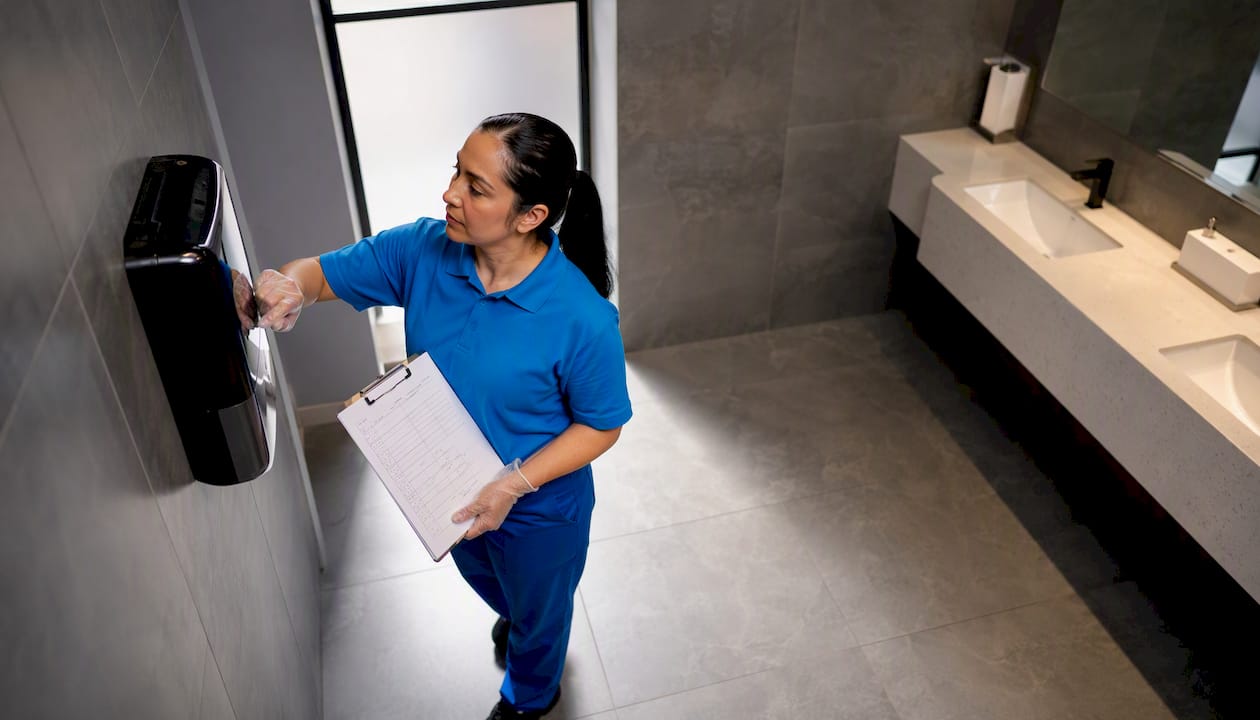
Table of Contents
- What do day porter services actually include?
- Which industries benefit most from daytime porter coverage?
- How do you build a customized day porter schedule?
- What are the real operational benefits of hiring a day porter?
- What should you expect from a professional provider?
- How is pricing determined, and what affects your quote?
- Day porter vs. janitor: what is the actual difference?
- How to evaluate and hire a day porter provider
- Why Lightning Cleaning for day porter services in Durham Region
- Key Takeaways
- What facility managers often get wrong about daytime coverage
- Get a free on-site quote from Lightning Cleaning
- Useful sources
- FAQ
What do day porter services actually include?
Day porter duties cover a broad range of routine and reactive tasks, all performed while the building is in use. Here is what a standard program typically covers:
- Lobby and entrance upkeep (sweeping, mopping, glass spot-cleaning, mat straightening)
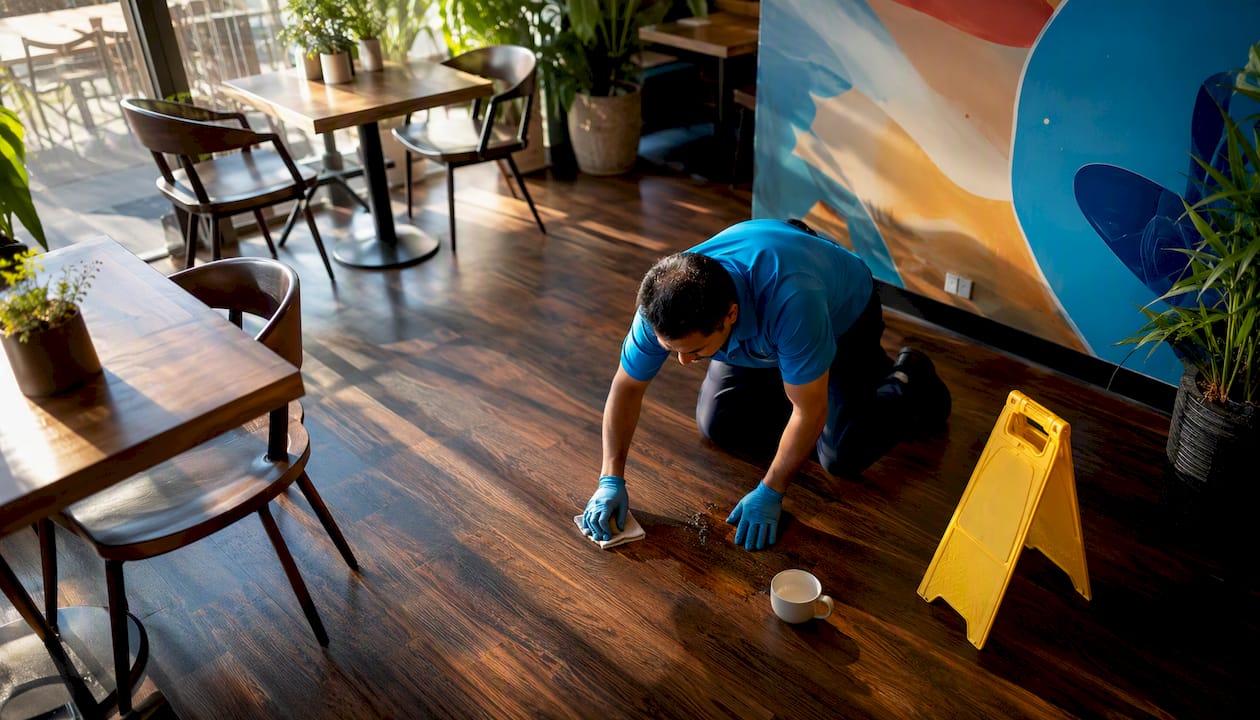
- Restroom checks, restocking (paper towels, soap, toilet paper), and sanitizing
- Trash and recycling rounds throughout common areas and break rooms
- Touchpoint disinfection: door handles, elevator buttons, light switches, reception counters
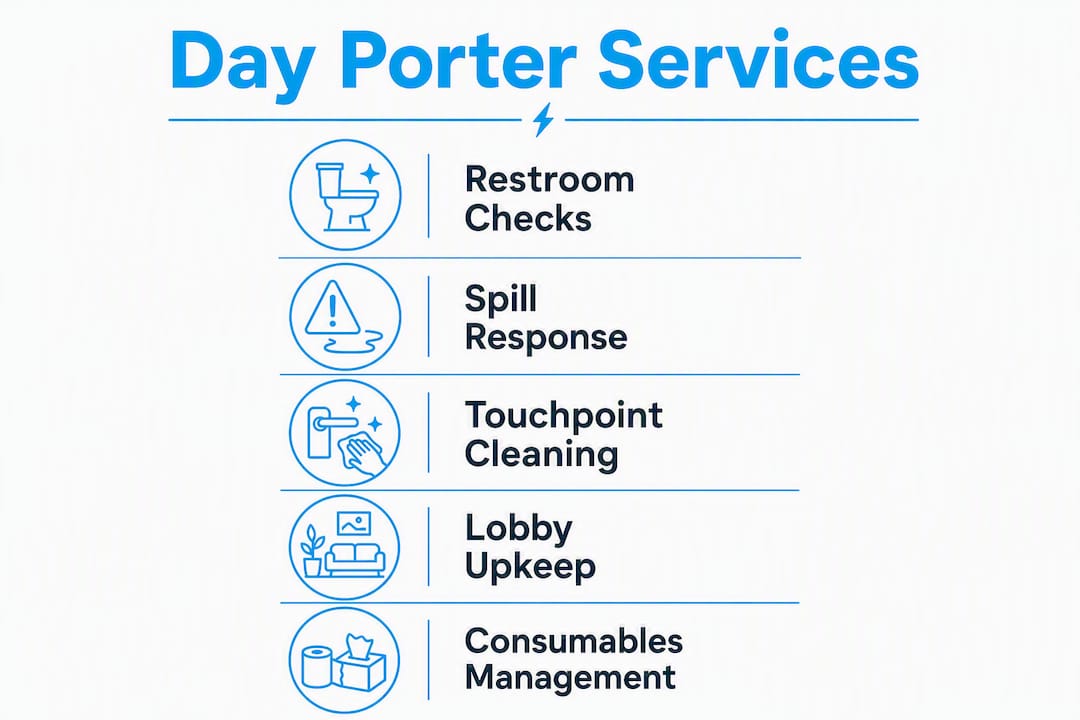
- Spot mopping and carpet spot treatment for spills
- Conference-room resets between meetings (chairs, surfaces, whiteboards)
- Break-room and kitchen touch-ups after peak use periods
- Coordination of small deliveries and minor receiving tasks
A well-written service level agreement (SLA) should specify frequency and timing for each task. A practical baseline: restroom checks every one to two hours during peak traffic, touchpoint disinfection every two to four hours, and trash rounds at least twice per shift.
Pro Tip: Map your task checklist to your building’s traffic peaks, not to a fixed clock. A medical clinic with back-to-back morning appointments needs restroom checks every hour before noon; the same clinic may need only two checks in the afternoon. Ask your provider to maintain a written incident log — it creates accountability and gives you data to refine the schedule over time.
Which industries benefit most from daytime porter coverage?
High-traffic, client-facing facilities see the clearest return on daytime cleaning coverage. The industries where a day porter makes the biggest operational difference include:
- Office buildings and multi-tenant properties — frequent meetings, shared restrooms, and lobby foot traffic create mid-day degradation that night crews cannot address.
- Medical clinics and healthcare reception areas — patient flow between appointments demands continuous surface disinfection. Lightning Cleaning’s medical facility cleaning protocols align directly with these needs.
- Schools — lunch periods generate concentrated mess in cafeterias and washrooms. A porter during the lunch window keeps spaces usable for afternoon classes. See Lightning Cleaning’s school cleaning programs for how scheduled coverage works in educational settings.
- Retail plazas and car dealerships — showroom floors and fitting rooms need continuous attention; a single spill or cluttered display can affect a sale.
- Industrial reception and administrative areas — front-of-house spaces at manufacturing or warehouse sites carry the same professional expectations as any office.
- Event spaces — between-session resets and rapid spill response are non-negotiable when guests cycle through a venue.
The clearest signal that your facility needs daytime coverage: walk the building at opening, mid-day, and late afternoon and compare conditions. If restrooms degrade noticeably by noon, spills sit unaddressed for more than a few minutes, or your own staff are regularly diverting time to cleaning tasks, a day porter program will pay for itself quickly.
How do you build a customized day porter schedule?
Effective programs are built around your facility’s traffic patterns, not a generic template. The table below shows four common coverage tiers and what each typically delivers.
| Coverage tier | Hours per week | Typical tasks covered | Best fit |
|---|---|---|---|
| Peak-hours only | 4–6 hrs/day | Lobby, restrooms, spill response, trash rounds | Small offices, low-traffic retail |
| Part-time | — | All above + conference-room resets, break-room rounds | Mid-size offices, clinics |
| Full-time on-site | — | Full task list + consumables management, light maintenance | Large buildings, schools, industrial sites |
| Event/seasonal | As needed | Rapid resets, post-event cleanup, temporary restocking | Event venues, seasonal retail |
A sample daily schedule for a part-time program might look like this: 8:00–10:00 AM, entrance setup and first restroom check; 11:00 AM–2:00 PM, lunch-area rounds and restroom checks every 60 minutes; 2:00–4:00 PM, conference-room resets and afternoon touchpoint disinfection cycle.
Common add-ons worth discussing with your provider: consumables management (ordering and stocking paper products and soap), detailed interior glass cleaning, light maintenance tasks like bulb replacement, and coordination with junk removal or cleanout services during office moves or large clearouts. Successful programs focus on high-frequency touchpoints and stay flexible enough to pivot to immediate needs — a post-lunch kitchen cleanup or an unscheduled conference-room flip — rather than following a rigid checklist regardless of what the building actually needs.
What are the real operational benefits of hiring a day porter?
The business case goes well beyond a clean lobby. Here is where the value shows up in practice:
- Continuous presentation: client-facing spaces stay presentable throughout the day, not just at opening.
- Faster issue resolution: a porter on-site can respond to a spill in minutes; a night crew cannot respond until hours later.
- Staff focus: your employees stop diverting time to cleaning tasks and stay on their core responsibilities.
- Conference-room readiness: rooms are reset between meetings without scheduling gaps.
- Reduced administrative burden: outsourcing daytime coverage removes the hiring, training, and scheduling overhead of managing cleaning staff directly.
On the safety side, immediate spill response is the most direct liability reducer a facility manager can deploy. Documented cleaning programs and rapid response protocols can lower slip-and-fall incidents, and facilities with due-diligence records may see lower insurance premiums as a result.
Energy savings: Transitioning to daytime cleaning can reduce building energy consumption by up to 8% by eliminating the need for overnight lighting and HVAC to support a late-night crew.
Day porters also act as the building’s eyes and ears. They are the first to notice a leaking fixture, a burnt-out light, or a loose handrail — small issues that escalate into expensive repairs when they sit undetected until the next scheduled inspection.
Pro Tip: A porter’s visible presence during business hours builds tenant and employee trust in ways that invisible overnight cleaning cannot. When occupants see someone actively maintaining the building, they report issues faster and feel more confident in the facility’s management.
What should you expect from a professional provider?
Before signing any agreement, request these specific documents and verify each one:
- Certificate of insurance — general liability and workers’ compensation, current and naming your property.
- Written service agreement or SLA — task list, frequencies, response time commitments, and escalation procedures.
- Worker screening documentation — background check policy and hiring standards.
- Training program description — orientation records, on-the-job checklists, and supervisor sign-off procedures.
- Incident log format — how the porter records and reports issues found during rounds.
- References from similar facilities — ask for at least two from properties comparable to yours in size and industry.
Supervision matters as much as the checklist. Ask how often a supervisor visits the site, what the staff-to-supervisor ratio is, and how the provider handles turnover. High turnover in day porter staff is a real operational risk: a new porter unfamiliar with your building’s layout and priorities will underperform for weeks. A provider with structured onboarding and low turnover is worth paying a premium for.
How is pricing determined, and what affects your quote?
Day porter pricing in Canada varies based on several factors. Standard rates run approximately CAD $30–$40 per hour depending on the scope of duties and local labor rates. Your total monthly cost depends on:
- Facility size (square footage and number of floors)
- Traffic level (number of occupants and daily visitors)
- Hours and frequency (peak-only vs. full-time coverage)
- Scope of duties (restocking, light maintenance, consumables management)
- Consumables supply (whether the provider supplies paper products and soap or you do)
A typical onboarding timeline runs like this: site walk and needs assessment (week one), scope finalization and SLA drafting (week two), a 30-day trial period with weekly reporting, then schedule adjustment and long-term contract execution.
When comparing quotes, ask every provider to itemize the same line items so you are comparing equivalent scopes. A lower hourly rate that excludes consumables management or supervisor visits may cost more in practice than a higher rate that includes them.
- Confirm whether consumables are included or billed separately.
- Ask what happens when the assigned porter calls in sick (backup coverage policy).
- Verify whether the quote includes supervisor site visits and how often.
- Check whether the SLA includes measurable KPIs (e.g., restroom check frequency, response time for spills).
Day porter vs. janitor: what is the actual difference?
The distinction is straightforward: a day porter works during business hours and handles real-time, visible maintenance. A janitorial or night crew works after hours and performs scheduled, restorative deep cleaning. Both roles are necessary in most commercial facilities; they are not interchangeable.
| Function | Day porter | Night crew / janitor |
|---|---|---|
| Working hours | During business hours | After hours or overnight |
| Primary focus | Visible upkeep, immediate response | Deep cleaning, restorative tasks |
| Spill response | Immediate | Next scheduled visit |
| Restroom service | Multiple checks per shift | Full clean once per night |
| Floor care | Spot mopping, touch-ups | Stripping, waxing, deep scrubbing |
| Carpet care | Spot treatment | Deep extraction cleaning |
| Interaction with occupants | Frequent | Minimal |
A facility that runs heavy foot traffic during the day and needs deep floor care periodically needs both. A small office with light daytime traffic and no client-facing lobby may manage with night-only janitorial service. The hybrid model — a part-time day porter plus a weekly or nightly janitorial crew — is the most common arrangement for mid-size commercial properties in Durham Region.
How to evaluate and hire a day porter provider
Work through this checklist before signing any contract.
- Assess your facility’s peak hours — walk the building at opening, mid-day, and late afternoon to identify where conditions degrade fastest.
- Define your minimum task list — restrooms, lobby, touchpoints, trash rounds, and any facility-specific needs (e.g., clinic between-patient disinfection).
- Set measurable KPIs — restroom check frequency, spill response time, conference-room reset time.
- Request itemized quotes from at least two providers, with identical scope so bids are comparable.
- Ask these interview questions:
- What is your supervisor-to-porter ratio, and how often does a supervisor visit this site?
- How do you handle sick days or no-shows?
- What is your average staff turnover rate?
- Can you provide a sample SLA and incident log format?
- How do you handle a maintenance issue the porter identifies (e.g., a leak or broken fixture)?
- Verify insurance — request a current certificate of insurance before the site walk.
- Check references — contact at least one reference from a facility similar to yours.
- Start with a 30-day trial — build a trial period into the contract with defined review criteria.
Red flags to watch for: vague scope with no task frequencies, unitemized quotes, no proof of insurance, inability to provide references, and no clear answer on backup coverage for absences. A provider who cannot describe their training program in specific terms is unlikely to deliver consistent results.
Why Lightning Cleaning for day porter services in Durham Region
Lightning Cleaning serves commercial facilities across Durham Region, including Oshawa, Whitby, Ajax, Pickering, and Clarington, with a full range of office cleaning services and specialized programs for medical clinics, schools, and industrial sites.
Our day porter programs are built around your facility’s actual traffic patterns. We conduct an on-site assessment before writing any SLA, so the task list and schedule reflect your building’s real needs — not a generic template. Staff are trained and supervised, and we maintain incident logs so you have a clear record of what was done and when.
Services that map directly to day porter needs: office cleaning, medical facility cleaning, school cleaning, industrial cleaning, janitorial services, floor waxing and carpet cleaning, and commercial window cleaning. We are fully insured, and every program comes with a written service agreement.
| |
Key Takeaways
Day porter services are the most direct way to maintain a clean, safe, and presentable commercial facility during operating hours, with customizable programs starting from peak-hours coverage up to full-time on-site staffing.
| Point | Details |
|---|---|
| Core duties | Restroom checks, touchpoint disinfection every 2–4 hours, spill response, trash rounds, and conference-room resets. |
| Pricing range | Standard day porter rates in Canada vary by scope and facility size. |
| Energy benefit | Transitioning to daytime cleaning can reduce building energy consumption by up to 8% by eliminating overnight HVAC and lighting needs. |
| Day porter vs. janitor | Day porters handle real-time visible upkeep during business hours; night crews perform scheduled deep cleaning after hours. |
| Lightning Cleaning | Serves Durham Region facilities with customizable day porter programs, on-site assessments, written SLAs, and full insurance coverage. |
What facility managers often get wrong about daytime coverage
Most facility managers I speak with in Durham Region underestimate one thing: the difference between a clean building at 8 AM and a clean building at 2 PM. Night crews do excellent restorative work, but they cannot address what happens between 9 AM and 5 PM. The facilities that struggle most are the ones that added a day porter only after a tenant complaint or a slip-and-fall incident — not before.
The other pattern worth naming: managers often focus on hourly rate when comparing providers and miss the more important variables — supervisor visit frequency, turnover rate, and whether the porter actually knows the building’s layout and priorities after week two. A well-structured onboarding program and low staff turnover are worth more than a $2/hour difference in rate.
What we have found at Lightning Cleaning is that the first 30 days of a program are where the real work happens. That is when we refine the schedule, identify the building’s actual pressure points, and build the reporting cadence that keeps facility managers informed without adding to their workload. Durham Region facilities tend to have specific seasonal patterns too — heavier foot traffic in winter months when people track in salt and slush — and a local provider who knows that context adjusts proactively rather than waiting to be told.
Get a free on-site quote from Lightning Cleaning
Lightning Cleaning offers free on-site assessments for commercial facilities across Durham Region. We will walk your building, identify your peak-traffic pressure points, and deliver a written quote with a customized task program and SLA — no generic pricing, no guesswork. Programs can start within days of agreement, and every contract includes a structured trial period so you can verify results before committing long-term.
Call 289-355-9691 today to schedule your assessment, or visit our commercial cleaning services page to learn more about coverage in Whitby, Oshawa, Ajax, Pickering, and Clarington. Ask specifically for a day porter assessment tailored to your facility type and operating hours.
Useful sources
- What Is Day Porter Cleaning? Roles, Tasks, and When You Need Porter Cleaning Services — StonesPlace explainer on operational assessment methods and use cases.
- IFMA (International Facility Management Association) — industry guidance on daytime cleaning transitions and energy management in commercial facilities.
Claims in this article are supported by industry guidance and Canadian market context. For precise pricing and scope, an on-site assessment is the only reliable starting point.
FAQ
What are the duties of a day porter?
A day porter handles real-time cleaning and maintenance during business hours: restroom checks and restocking, touchpoint disinfection every two to four hours, spill response, trash rounds, lobby upkeep, and conference-room resets between meetings.
What is the difference between a day porter and a janitor?
A day porter works during operating hours and focuses on visible, immediate upkeep. A janitor or night crew works after hours and performs scheduled deep cleaning tasks like floor stripping, carpet extraction, and full restroom sanitizing.
How much do day porter services cost in Canada?
Standard rates run approximately CAD $30–$40 per hour, depending on facility size, scope of duties, and local labor rates. Monthly costs vary based on whether you need peak-hours, part-time, or full-time coverage.
How often should restrooms be checked during the day?
For most commercial facilities, restroom checks every one to two hours during peak traffic periods are a practical baseline. High-traffic facilities like medical clinics or schools may need checks every 30–60 minutes during busy periods.
How do I get a day porter quote for my Durham Region facility?
Call Lightning Cleaning at 289-355-9691 to schedule a free on-site assessment. We will review your facility’s size, traffic patterns, and task requirements before providing a written quote with a customized SLA.


