


Chemical resistant cleaning equipment is defined as specialized tools, protective clothing, and personal protective gear made from materials that resist degradation when exposed to industrial chemicals, solvents, acids, and disinfectants. For facility managers and cleaning professionals in Ontario, selecting the right types of chemical resistant cleaning equipment is not optional. Provincial Occupational Health and Safety (OHS) regulations require employers to provide appropriate PPE at no cost and conduct annual documented training reviews. The standard industry term for this category is “chemical resistant PPE and equipment,” and it covers everything from nitrile gloves to PTFE-coated tools and certified protective suits.
1. What are the main types of chemical resistant gloves?
Gloves are the first line of defense in any chemical handling task. Nitrile, neoprene, and butyl rubber are the three standard glove materials used in industrial and commercial cleaning, and each covers a different range of chemical hazards.
- Nitrile gloves offer excellent resistance to solvents, oils, and punctures. They are the most common choice for general facility cleaning involving degreasers and disinfectants.
- Neoprene gloves resist acids, bases, and oils. They work well in environments where cleaning staff handle both acidic and alkaline solutions.
- Butyl rubber gloves protect against gases, ketones, and esters. They are the correct choice when staff work with highly aggressive chemicals or concentrated solvents.
Glove selection must follow the chemical’s Safety Data Sheet (SDS). The SDS identifies the specific permeation rate of a chemical through a given material. Choosing based on general labels alone creates real exposure risk.
Thickness and reusability also matter. Thicker gloves last longer but reduce dexterity. Reusable gloves require inspection before each use for cracks, pinholes, or discoloration. Ontario OHS regulations require that glove selection be documented and reviewed annually.
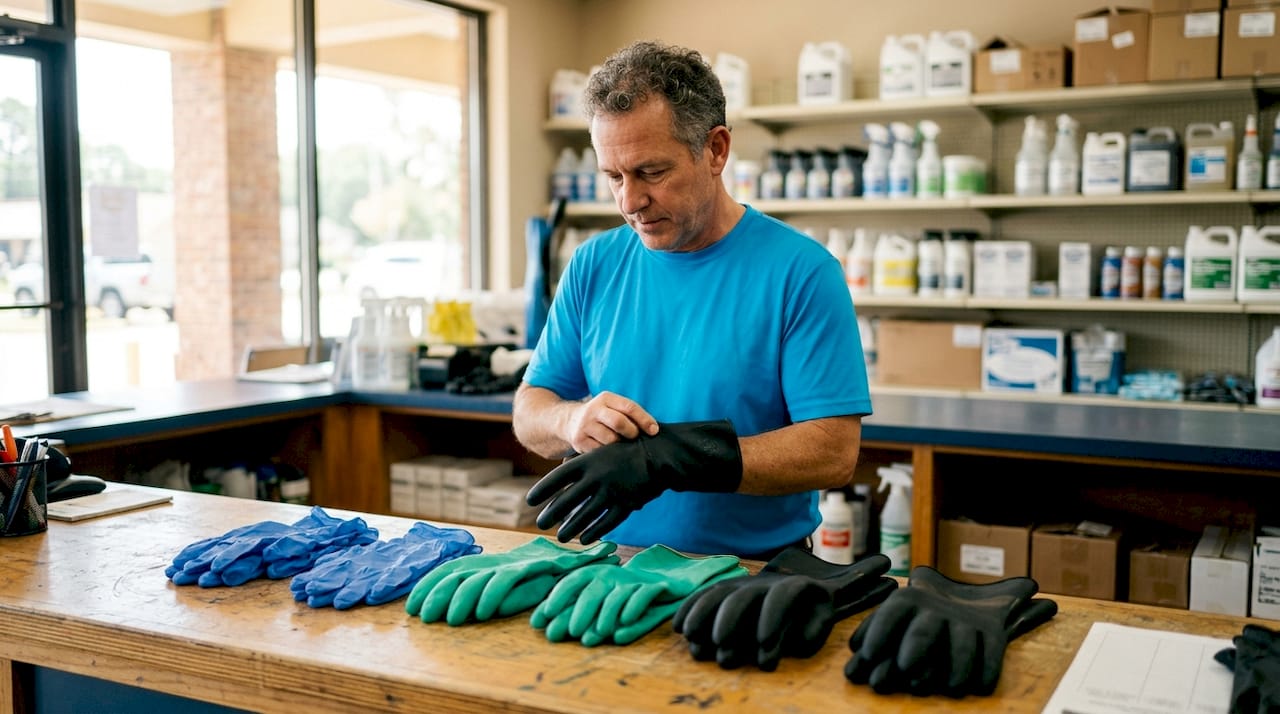
Pro Tip: Always cross-reference the glove manufacturer’s chemical resistance chart with the SDS for every product your team uses. A glove rated for one solvent may fail within minutes against a different one.
2. What chemical resistant protective clothing options are available?
Protective clothing for chemical handling falls into three main categories: full suits, coveralls, and aprons. Each serves a different exposure level.
- Full chemical resistant suits use materials like fluoropolymers, including PTFE, for extreme environments involving splash, vapor, or immersion risk. They are appropriate for industrial cleaning tasks with high chemical concentrations.
- Coveralls made from laminated fabrics or polyethylene provide a middle tier of protection. They suit tasks with moderate splash risk, such as floor stripping with alkaline cleaners.
- Aprons protect the torso and upper legs during light to moderate splash tasks. They are common in medical facility and food service cleaning environments.
Certified protective clothing balances durability, chemical resistance, comfort, and breathability. Seam construction is a critical factor. Sewn seams allow chemical penetration. Taped or welded seams provide a sealed barrier and are required for higher-hazard tasks.
The table below summarizes the key differences between clothing types:
| Clothing type | Material examples | Best use case |
|---|---|---|
| Full suit | PTFE, fluoropolymers | High-concentration chemical exposure |
| Coverall | Polyethylene, laminated fabric | Moderate splash risk |
| Apron | PVC, neoprene | Light splash, routine cleaning tasks |
Comfort matters for compliance. Staff who find protective clothing uncomfortable tend to remove it early or avoid wearing it correctly. Selecting breathable, well-fitting garments improves consistent use.
3. How do chemical resistant cleaning tools ensure durability and safety?
Cleaning tools made from chemically resistant materials prevent equipment failure and cross-contamination. The most common highly durable cleaning tools include brushes, scrubbers, squeegees, and steam cleaners built from materials like PTFE-coated surfaces, polypropylene, and CPVC.
- PTFE-coated brushes and scrubbers resist aggressive acids and solvents. They maintain structural integrity where standard plastic tools would crack or dissolve.
- Polypropylene mop handles and buckets resist most diluted acids and alkalis. They are the standard choice for general commercial and janitorial cleaning.
- CPVC piping and fittings on floor scrubbers and wet vacuums handle higher chemical concentrations than standard PVC. They are common in industrial cleaning equipment.
- Electric steam cleaners provide chemical-free sanitation that meets HACCP and food safety standards. All-electric steam cleaners produce no exhaust and comply with CAN/CSA-C22.2 certification requirements.
- Industrial floor scrubbers with chemical-resistant tanks and seals handle concentrated cleaning solutions without tank degradation. Material compatibility between the tank and the cleaning agent determines equipment lifespan.
The table below shows tool materials and their chemical compatibility:
| Tool material | Chemical compatibility | Common application |
|---|---|---|
| PTFE coating | Acids, solvents, oxidizers | Brushes, gaskets, seals |
| Polypropylene | Diluted acids, alkalis | Mop handles, buckets |
| CPVC | Concentrated acids, chlorine | Scrubber tanks, fittings |
| Stainless steel | Alkalis, mild acids | Steam cleaner bodies |
Matching cleaning chemistry to the substrate and tool material prevents equipment damage and protects surfaces like steel and aluminum. An inhibited acid cleaner used in a polypropylene bucket will not degrade the bucket. The same acid in a standard aluminum container causes rapid corrosion.
4. What PPE complements chemical resistant gear for full protection?
Chemical resistant gloves and suits alone do not provide complete protection. Eye, face, and respiratory protection are required for most industrial and commercial chemical cleaning tasks.
- Chemical splash goggles rated to ANSI Z87.1 protect against liquid splashes and vapor. Standard safety glasses do not seal around the eyes and are not appropriate for chemical work.
- Face shields add a second layer of protection over goggles when splash risk is high. They protect the face and neck from large-volume splashes.
- Respirators certified to CSA Z94.4 or NIOSH standards protect against chemical vapors, mists, and particulates. Half-face respirators suit most cleaning tasks. Full-face respirators are required when vapor concentrations are high or when goggles alone are insufficient.
- Chemical resistant footwear compliant with CSA Z195 protects against spills and standing chemical exposure. Standard rubber boots are not always rated for chemical resistance.
Provincial OHS regulations require mandatory fit testing for every respirator make, model, and size. Fit testing is not a one-time event. Staff who change respirator models or whose facial structure changes require retesting. Documented fit testing records are required for provincial audits.
Pro Tip: Keep a PPE inspection log at each facility. Record glove and respirator checks before every shift. This log is your first line of defense during an OHS inspection.
5. Why chemical compatibility matters more than the label
A “chemical resistant” label on a glove, suit, or tool does not mean it resists every chemical. Material degradation occurs based on the specific permeation rate of each chemical through each material. A nitrile glove that resists acetone may fail quickly against methylene chloride.
Facility managers need to conduct a Job Hazard Analysis (JHA) for every cleaning task involving chemicals. The JHA identifies each chemical in use, its concentration, and the exposure route. That information drives equipment selection. Relying on a single “chemical resistant” label across all tasks is the most common procurement error in facility management.
Matching resin chemistry to chemical type and pH also applies to equipment coatings and flooring. Standard epoxy coatings fail under high acid concentrations. Novolac or vinyl ester materials succeed where standard epoxies degrade. The same principle applies to tool coatings and tank liners in cleaning equipment.
The best cleaning equipment for chemicals is always the equipment matched to the specific hazard, not the equipment with the broadest marketing claim. Procurement decisions based on JHA findings and SDS data produce better safety outcomes and longer equipment lifespans.
6. How to select and maintain chemical resistant gear over time
Equipment selection is a one-time decision. Maintenance is an ongoing responsibility. Chemical resistant gear degrades with use, improper storage, and chemical exposure over time.
Gloves should be inspected before every use. Look for discoloration, stiffness, cracks, or swelling. Any of these signs indicate chemical permeation or material breakdown. Retire the gloves immediately. Protective suits and coveralls require inspection after each use for tears, seam separation, or contamination. Contaminated suits must be decontaminated before storage or disposal, following the SDS guidance for the chemical involved.
Industrial cleaning equipment such as floor scrubbers and steam cleaners requires scheduled maintenance checks on tanks, seals, and hoses. A degraded seal on a scrubber tank can expose operators to concentrated cleaning solution. Maintenance logs tied to equipment serial numbers provide traceability and support compliance documentation.
Storage conditions affect equipment lifespan. UV light, heat, and ozone degrade rubber and polymer materials. Store gloves, suits, and boots in cool, dark, dry conditions away from motors and electrical equipment that generate ozone.
Key Takeaways
Selecting chemical resistant cleaning equipment requires matching materials to specific chemical hazards identified through Safety Data Sheets, Job Hazard Analysis, and Ontario OHS compliance requirements.
| Point | Details |
|---|---|
| Match materials to hazards | Nitrile, neoprene, and butyl rubber gloves each cover different chemical types. |
| Verify clothing certification | Taped or welded seams are required for high-hazard chemical exposure tasks. |
| Use certified cleaning tools | CAN/CSA-C22.2 compliant steam cleaners and PTFE-coated tools resist chemical degradation. |
| Complete your PPE system | ANSI Z87.1 goggles, CSA Z94.4 respirators, and CSA Z195 footwear are required alongside gloves. |
| Document training and fit testing | Ontario OHS mandates annual reviews and respirator fit testing records for every worker. |
What I’ve learned about chemical resistant equipment in Canadian facilities
The single biggest mistake I see facility managers make is treating “chemical resistant” as a binary property. It is not. Every material has a resistance profile, and that profile changes based on chemical concentration, temperature, and contact duration. A glove that works perfectly at a 10% acid concentration may fail at 30%. That distinction does not appear on the label. It appears in the SDS and the manufacturer’s chemical resistance chart.
The second mistake is separating equipment procurement from training. You can buy the best nitrile gloves on the market, but if your cleaning staff does not know how to don and doff them correctly, contamination still happens. Ontario’s OHS requirements exist for exactly this reason. Documented training is not a formality. It is the mechanism that connects good equipment to actual protection.
For facility managers in Durham Region, the regulatory environment in 2026 is clear. Annual PPE program reviews, documented training, and mandatory respirator fit testing are legal requirements. The facilities that handle this well treat compliance as a procurement and scheduling function, not a paperwork exercise. They build inspection logs, fit testing schedules, and SDS reviews into their standard operating procedures.
My practical advice: start with your SDS library. Every chemical in your facility should have a current SDS on file. Build your equipment list from those documents. Then verify that your janitorial services provider follows the same standard. If they cannot show you their training records and equipment compatibility documentation, that is a gap worth addressing.
— William
Lightning Cleaning’s approach to chemical resistant facility cleaning
Facility managers across Durham Region trust Lightning Cleaning to handle industrial and commercial cleaning tasks that require proper chemical resistant protocols and trained staff.

Lightning Cleaning’s industrial cleaning services cover facilities in Oshawa, Whitby, Ajax, Pickering, and Clarington. Our teams use chemical resistant gear matched to each facility’s specific cleaning agents and substrates. We follow Ontario OHS requirements for PPE, training documentation, and equipment compatibility. Whether you manage a medical facility, school, or commercial space, we provide reliable cleaning backed by proper equipment and trained professionals. Call us at 289-355-9691 for a free on-site quote.
FAQ
What is chemical resistant cleaning equipment?
Chemical resistant cleaning equipment includes gloves, protective suits, aprons, respirators, and tools made from materials like nitrile, neoprene, PTFE, and polypropylene that resist degradation when exposed to industrial chemicals. These materials are selected based on Safety Data Sheet guidance and the specific chemical hazards present in a facility.
Which glove material offers the best chemical resistance?
Butyl rubber provides the highest resistance to gases, ketones, and concentrated solvents, while nitrile suits most general solvent and disinfectant tasks. The correct choice depends on the specific chemicals identified in the Safety Data Sheet for each cleaning task.
Are Ontario employers required to provide chemical resistant PPE?
Ontario OHS regulations require employers to provide PPE at no cost, conduct annual documented training reviews, and perform mandatory respirator fit testing for every make, model, and size used by workers.
What cleaning tools are considered highly durable for chemical environments?
PTFE-coated brushes, polypropylene mop handles, CPVC-fitted floor scrubbers, and CAN/CSA-C22.2 certified electric steam cleaners are the most durable options for chemical cleaning environments. Material compatibility with the specific cleaning agent determines which tool is appropriate for each task.
How often should chemical resistant gear be inspected?
Gloves and protective suits should be inspected before every use for cracks, discoloration, or seam separation. Respirators require fit testing whenever the model changes or a worker’s facial structure changes, with records maintained for provincial OHS audits.


